Birding in TAMBOPATA
A Complete Guide to Birding Tambopata National Reserve
Tambopata is one of the most accessible and rewarding Amazon birding destinations in Peru. Located in the lowland rainforest of Madre de Dios, near Puerto Maldonado, this region offers birders a remarkable combination of macaw clay licks, oxbow lakes, canopy viewpoints, riverine forest, terra firme trails, and comfortable rainforest lodges.
For travelers looking to experience Amazon birdwatching without the long overland logistics of more remote routes, Tambopata National Reserve is one of the best options in southern Peru. Within a short itinerary, birders can explore classic Amazonian habitats and look for macaws, toucans, aracaris, cotingas, antbirds, woodcreepers, jacamars, puffbirds, manakins, raptors, and many other lowland rainforest specialties.
Tambopata also works exceptionally well as an extension after Cusco, Machu Picchu, Manu Road, or a broader Peru birding itinerary. With direct flights to Puerto Maldonado and excellent lodge-based birding, it is an ideal destination for birders who want a rich Amazon experience with efficient logistics, impressive wildlife, and expert-guided birding in one of Peru’s most iconic rainforest regions.
.
Table of Contents
Why Go Birding in Tambopata National Reserve?
Tambopata is one of the most rewarding Amazon birding destinations in Peru because it combines accessibility, biodiversity, and a wide variety of rainforest experiences within a relatively short itinerary. From Puerto Maldonado, travelers can quickly reach productive lodge areas, forest trails, river habitats, oxbow lakes, canopy towers, and clay lick areas, making it an ideal choice for birders who want a true Amazon experience without overly complex logistics.
For travelers visiting Cusco, Machu Picchu, or Manu Road, Tambopata National Reserve works especially well as a natural Amazon extension. In just a few days, birders can add lowland rainforest species, iconic Amazon scenery, and memorable wildlife encounters to a broader Peru birding itinerary.
1. Easy Access to the Amazon Through Puerto Maldonado
Tambopata is one of the easiest Amazon birding destinations to combine with a Peru trip. Most travelers arrive through Puerto Maldonado, with flight connections from Lima or Cusco, before continuing by road and/or boat to their rainforest lodge. This makes Tambopata especially practical for birders who want a real Amazon experience without spending several extra days on long overland transfers.
2. Perfect Extension After Cusco, Machu Picchu or Manu Road
Tambopata fits naturally after the main highlights of southern Peru. After visiting Cusco, the Sacred Valley, Machu Picchu, or the cloud forests of Manu Road, birders can add a completely different set of lowland Amazon birds and wildlife. This makes Tambopata an excellent extension for travelers who want to connect the Andes, cloud forest, and Amazon rainforest in a single journey.
3. Several Classic Amazon Birding Experiences in Just a Few Days
One of Tambopata’s greatest strengths is the variety of birding experiences available within a compact itinerary. In a few days, travelers may explore primary forest trails, river edges, oxbow lakes, canopy towers, and macaw or parrot clay lick areas. This combination gives birders access to different layers of the rainforest and different groups of species without needing a long expedition.
4. Comfortable Lodge-Based Birding with Strong Wildlife Value
Tambopata’s lodge-based model allows birders to explore the rainforest efficiently while staying in comfortable accommodations surrounded by nature. Well-located lodges provide access to trails, river habitats, night walks, canopy viewpoints, and nearby birding sites. Beyond birds, Tambopata National Reserve and its surrounding forests can also offer memorable wildlife encounters, including Giant Otters, monkeys, caimans, reptiles, amphibians, and other Amazonian species.
Tambopata Birding Route
The Tambopata birding route begins in Puerto Maldonado, the main gateway to the southern Peruvian Amazon. From here, travelers connect by road and/or boat to rainforest lodges located near the Tambopata River, the Madre de Dios River, oxbow lakes, forest trails, canopy towers, and macaw clay lick areas. This makes Tambopata one of the most practical Amazon birding destinations in Peru, especially for travelers who want to combine rainforest birding with Cusco, Machu Picchu, Manu Road, or a broader Peru itinerary.
Unlike mountain routes where birding changes mainly by elevation, Tambopata is best understood through its key Amazonian experiences: river-based access, rainforest lodge birding, macaw and parrot clay licks, oxbow lakes, and canopy viewpoints. A well-designed itinerary should not focus on only one site, but combine these habitats and experiences to create a richer introduction to the lowland rainforest.
Depending on the lodge and number of days available, birders may visit famous sites such as the Chuncho Macaw Clay Lick, nearby parrot clay licks, Lake Sandoval, Lake Chimbada, San Cristobal Lake, forest trail systems, river edges, and canopy towers. The exact route may vary according to lodge location, river conditions, seasonality, and the birding priorities of each traveler.
This map shows the general structure of a classic Tambopata birding route, starting in Puerto Maldonado and connecting the main Amazonian birding experiences of the region: rainforest lodges, macaw clay lick areas, oxbow lakes, and canopy birding points. Exact lodge locations and daily routes may vary depending on the selected itinerary, lodge availability, river conditions, and target species
Key Birding Experiences in Tambopata National Reserve
Birding in Tambopata National Reserve is best understood through four core Amazon birding experiences: lowland rainforest trails, macaw and parrot clay licks, oxbow lakes, and canopy towers. Each one gives access to a different part of the Amazon bird community, from secretive forest understory species to canopy birds, lake specialists, and large psittacids gathering at clay banks.
For serious birders, the value of Tambopata is not only the number of species, but the possibility of combining these four experiences within a compact Amazon itinerary. A well-planned Tambopata birding tour should therefore be built around habitat access, lodge location, early-morning timing, and the specific species groups each setting can produce.
1. Lowland Rainforest Birding
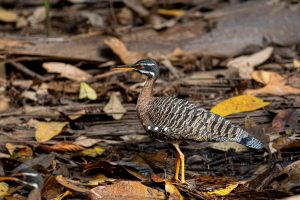
Lowland rainforest birding is the foundation of any serious Tambopata itinerary. This is where birders experience the core Amazonian forest community: antbirds, woodcreepers, manakins, puffbirds, jacamars, tinamous, foliage-gleaners, trogons, motmots, and mixed flocks moving through dense forest. Unlike open lake or clay lick birding, forest trail birding is more technical and depends heavily on sound, patience, and a guide who understands Amazonian bird behavior.
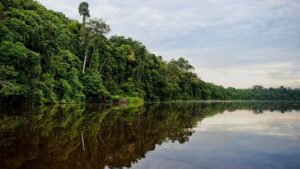
In Tambopata National Reserve and nearby lodge forests, mature terra firme forest, bamboo patches, seasonally flooded forest, and lodge trail systems can all produce different bird assemblages. This is the part of the trip where birders should slow down, listen carefully, and work specific territories rather than simply walking long distances.
Important target birds for lowland rainforest trails include:
- Pavonine Quetzal
- Rufous Motmot
- White-throated Tinamou
- Great Tinamou
- Black-fronted Nunbird
- White-necked Puffbird
- Bluish-fronted Jacamar
- Round-tailed Manakin
- Wedge-billed Woodcreeper
- Plain-brown Woodcreeper
- Black-faced Antbird
- Fasciated Antshrike
Birding value: This is the best setting for true Amazon forest birding: understory species, mixed flocks, vocal skulkers, antbirds, woodcreepers, manakins, puffbirds, jacamars, and tinamous. It is also where an expert birding guide makes the biggest difference.
2. Macaw and Parrot Clay Licks
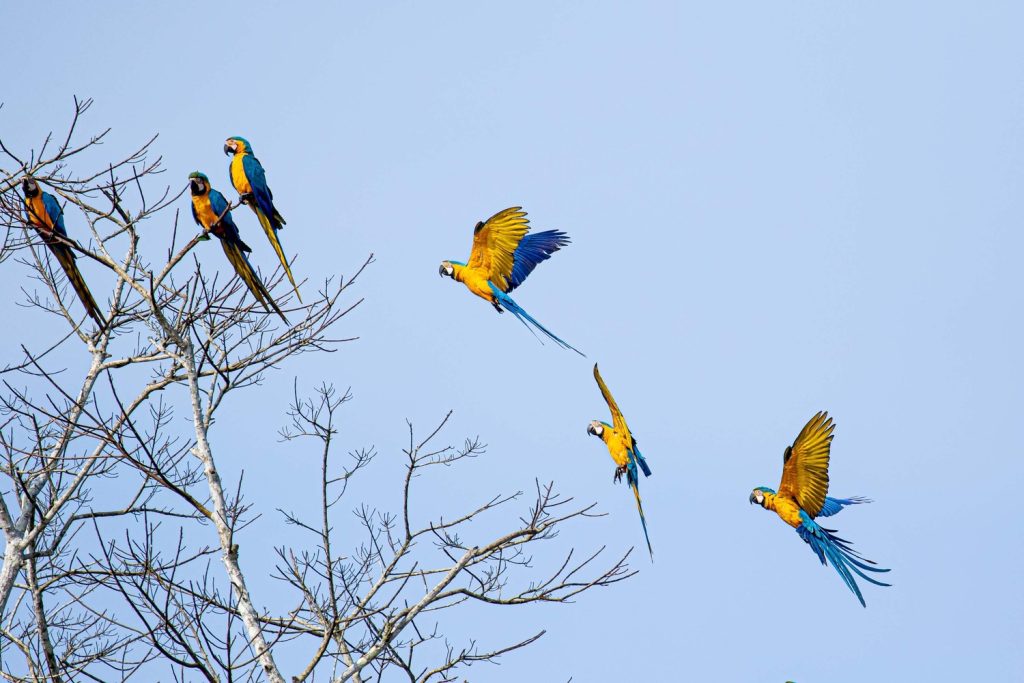
Macaw and parrot clay licks are among the most iconic birding experiences in Tambopata. The best-known site is the Chuncho Macaw Clay Lick, but depending on the lodge and itinerary, birders may also visit smaller parrot clay licks or lodge-access collpas. These clay banks are important because they concentrate macaws, parrots, and parakeets in open conditions, creating one of the most impressive birding scenes in the Amazon.
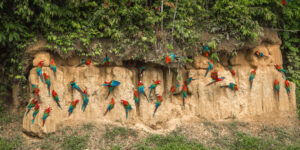
For birders, a clay lick is more than a colorful spectacle. It is a chance to compare psittacids by size, flight style, vocalization, flock behavior, and feeding activity. Early morning is usually the key time, but activity depends on weather, disturbance, seasonality, and natural feeding behavior. Rainforest Expeditions describes Tambopata clay licks as mineral-rich clay cliffs where macaws, parrots, and parakeets gather, especially in the morning.
Important target birds for clay lick areas include:
- Red-and-green Macaw
- Scarlet Macaw
- Blue-and-yellow Macaw
- Chestnut-fronted Macaw
- Blue-headed Macaw
- Mealy Parrot
- Yellow-crowned Amazon
- Orange-cheeked Parrot
- White-eyed Parakeet
- Dusky-headed Parakeet
- Cobalt-winged Parakeet
- Tui Parakeet
Birding value: This is the best experience for large macaws, parrots, parakeets, open views, photography, and behavior observation. It is also one of the strongest reasons to include Tambopata National Reserve in a Peru birding itinerary.
3. Oxbow Lakes
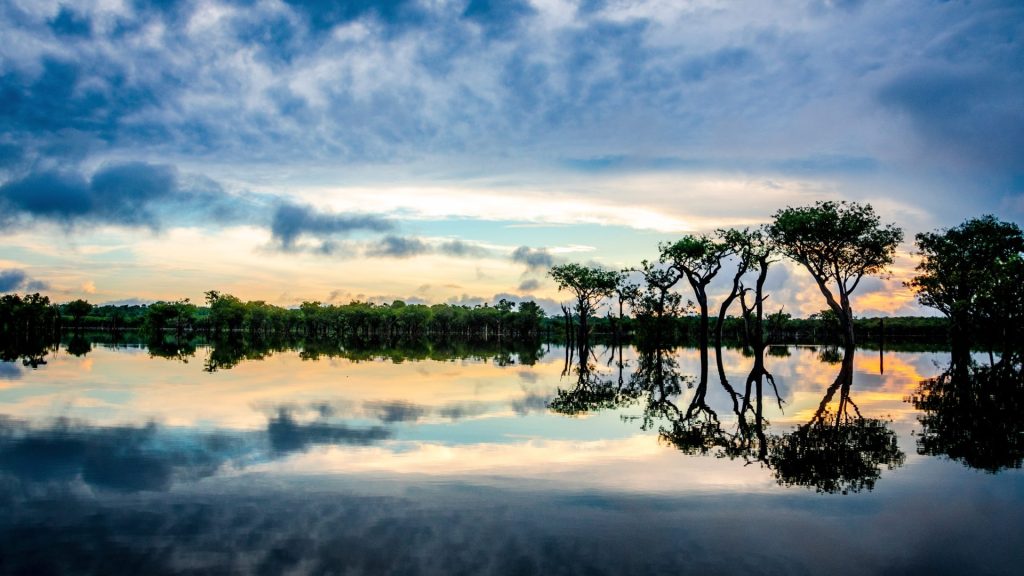
Oxbow lakes are essential in Tambopata because they open the forest and give birders access to species that are much harder to see from closed trails. Lakes such as Sandoval, Chimbada, San Cristobal, and other lodge-access cochas provide calm water, lakeside forest, Mauritia palm areas, floating vegetation, and forest edges where waterbirds and canopy birds can be observed from canoe or lake-edge trails.
Lake Sandoval is one of the best-known oxbow lakes in Tambopata National Reserve. Birdingplaces lists birds such as Hoatzin, Anhinga, Sungrebe, Green Ibis, Rufescent Tiger-Heron, Agami Heron, Capped Heron, several macaws, toucans, woodpeckers, and kingfishers for Lago Sandoval, and also notes Giant Otter as a frequent wildlife highlight.
Important target birds for oxbow lakes include:
- Hoatzin
- Sungrebe
- Agami Heron
- Rufescent Tiger-Heron
- Capped Heron
- Green Ibis
- Wattled Jacana
- Anhinga
- Amazon Kingfisher
- Green-and-rufous Kingfisher
- Pygmy Kingfisher
- Black-capped Donacobius
Birding value: Oxbow lakes are the best places for Hoatzin, kingfishers, herons, Sungrebe, lake-edge birds, open views, and relaxed canoe-based birding. They also add strong wildlife value, especially where Giant Otters are present.
4. Canopy Towers and Viewpoints
Canopy birding is a major reason to choose the right lodge in Tambopata. Many Amazonian birds spend most of their time in the upper forest, where they are difficult to see from ground-level trails. A canopy tower or elevated viewpoint allows birders to scan emergent trees, watch fruiting crowns, observe flyovers, and detect species that are often only heard from below.
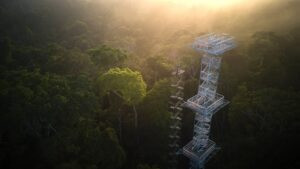
Several lodges in and around Tambopata National Reserve offer canopy towers, platforms, or elevated viewpoints. Field Guides’ 2024 Tambopata trip report, for example, mentions a canopy tower visit where Red-and-green and Scarlet Macaws were seen below eye level, showing how different canopy birding can be from ground-level forest birding.
Important target birds for canopy towers and viewpoints include:
- Spangled Cotinga
- Plum-throated Cotinga
- White-throated Toucan
- Channel-billed Toucan
- Curl-crested Aracari
- Ivory-billed Aracari
- Paradise Tanager
- Opal-rumped Tanager
- Green-and-gold Tanager
- Red-necked Woodpecker
- King Vulture
- Greater Yellow-headed Vulture
Birding value: Canopy towers are especially important for cotingas, toucans, aracaris, parrots, macaws, canopy tanagers, woodpeckers, and raptors. They also help birders understand the vertical structure of Amazon birding, from shaded understory to emergent canopy.
.
Best Birding Tours in Tambopata
Explore our best Tambopata birding tours, designed for travelers who want to experience Amazon birdwatching in Tambopata National Reserve with expert guides, comfortable rainforest lodges, macaw clay licks, oxbow lakes, canopy towers, and productive lowland forest trails.
Top Birding Hotspots in Tambopata
Tambopata National Reserve and the surrounding rainforest areas near Puerto Maldonado include some of the most productive lowland Amazon birding hotspots in Peru. From remote research stations and macaw clay licks to oxbow lakes, canopy towers, lodge trails, and riverine forest, these sites give birders access to very different groups of Amazonian birds. The following hotspots can help travelers understand how a Tambopata birding itinerary may be designed depending on time, lodge selection, and target species.
- Tambopata Research Center – Remote lowland rainforest birding, macaws, canopy species, and deep Amazon forest trails.
- Chuncho Macaw Clay Lick / Collpa Chuncho – Iconic macaw and parrot clay lick experience along the Tambopata River.
- Chuncho Lodge – Strategic lodge area for Tambopata River birding, forest trails, and access to nearby clay lick habitats.
- Refugio Amazonas Lodge – Productive rainforest lodge with forest trails, canopy tower access, and strong Amazon birding diversity.
- Finca Sachavacayoc – Lowland forest birding area with trails, lodge surroundings, and access to classic Tambopata rainforest species.
- Tres Chimbadas Lake – Oxbow lake birding for Hoatzin, kingfishers, herons, Sungrebe, and lakeside forest birds.
- Posada Amazonas Lodge – Excellent lodge-based birding with forest trails, canopy access, and nearby lake and river habitats.
- Puerto Maldonado – Gateway to Tambopata National Reserve, with river edges, secondary forest, and arrival-day birding opportunities.
- Cachuela Road & Cachuela Clay Lick – Accessible birding near Puerto Maldonado for parrots, parakeets, forest-edge birds, and open-country species.
- Inkaterra Hacienda Concepción – Comfortable lodge area with forest trails, wetland access, and productive birding near Tambopata National Reserve.
- Lake Sandoval & Lake Sandoval Trail – Classic Tambopata oxbow lake experience for Hoatzin, kingfishers, herons, Anhinga, and Giant Otter habitat.
- Inkaterra Reserva Amazonica – Rainforest lodge birding with trails, canopy access, river habitats, and lowland Amazon species.
- Lake Valencia – Large Amazonian lake habitat with waterbirds, forest-edge species, riverine birds, and broader wildlife value.
1. Tambopata Research Center
Tambopata Research Center is one of the strongest birding bases in the deeper Tambopata River sector. Its location offers access to mature lowland rainforest, riverine forest, clay lick areas, bamboo patches, and canopy-level birding. For serious birders, this is one of the most important areas to consider when looking for a deeper Amazon experience within the Tambopata region.
Important target birds:
Red-and-green Macaw, Scarlet Macaw, Blue-and-yellow Macaw, Blue-headed Macaw, White-throated Toucan, Channel-billed Toucan, Spangled Cotinga, Pavonine Quetzal, Black-fronted Nunbird, White-necked Puffbird, Round-tailed Manakin, and mixed-flock species.
eBird bird list: Tambopata Research Center
2. Chuncho Macaw Clay Lick / Collpa Chuncho
Chuncho Macaw Clay Lick is one of the most iconic birding sites in Tambopata National Reserve. Located along the Tambopata River, this site is especially important for macaws, parrots, and parakeets, offering one of the best opportunities in the region to observe several psittacid species in open conditions. Activity is usually strongest in the early morning, although it always depends on weather, seasonality, and natural bird behavior.
Important target birds:
Red-and-green Macaw, Scarlet Macaw, Blue-and-yellow Macaw, Chestnut-fronted Macaw, Blue-headed Macaw, Mealy Parrot, Yellow-crowned Amazon, Orange-cheeked Parrot, White-eyed Parakeet, Dusky-headed Parakeet, Cobalt-winged Parakeet.
eBird bird list: Chuncho Macaw Clay Lick / Collpa Chuncho
3. Chuncho Lodge
Chuncho Lodge works as a strategic birding base for travelers exploring the Tambopata River sector and the Collpa Chuncho area. Beyond its proximity to the macaw clay lick, the lodge surroundings can provide access to lowland forest trails, river-edge birding, and early-morning Amazon activity. This makes it useful for itineraries focused on macaws, rainforest birding, and river-based exploration.
Important target birds:
Red-and-green Macaw, Scarlet Macaw, Blue-headed Macaw, White-throated Toucan, Channel-billed Toucan, Curl-crested Aracari, Black-fronted Nunbird, Bluish-fronted Jacamar, Rufous Motmot, Wedge-billed Woodcreeper, and Yellow-rumped Cacique.
eBird bird list: Chuncho Lodge
4. Refugio Amazonas Lodge
Refugio Amazonas Lodge is one of the best-known lodge-based birding sites in the Tambopata region. It is especially valuable for travelers who want a strong combination of forest trails, canopy access, lodge surroundings, and general lowland rainforest birding without traveling as far upriver as Tambopata Research Center. For birders, this area can be productive for canopy birds, mixed flocks, understory species, and riverine forest birds.
Important target birds:
Pavonine Quetzal, Rufous Motmot, White-necked Puffbird, Black-fronted Nunbird, Bluish-fronted Jacamar, Round-tailed Manakin, Wedge-billed Woodcreeper, White-throated Toucan, Curl-crested Aracari, Spangled Cotinga, Paradise Tanager.
eBird bird list: Refugio Amazonas Lodge
.
Finca Sachavacayoc is a valuable lowland rainforest birding area in the Tambopata region, especially for birders interested in forest trails, lodge surroundings, riverine habitats, and Amazonian understory species. This area can be particularly useful for itineraries that want to combine comfortable lodge-based birding with access to classic rainforest birds away from the busier entrance zones.
Important target birds:
Great Tinamou, White-throated Tinamou, Pavonine Quetzal, Rufous Motmot, White-necked Puffbird, Black-fronted Nunbird, Bluish-fronted Jacamar, Plain-brown Woodcreeper, Wedge-billed Woodcreeper, Black-faced Antbird, and mixed-flock species.
eBird bird list: Finca Sachavacayoc
6. Tres Chimbadas Lake
Tres Chimbadas Lake is one of the key oxbow lake birding sites in the Tambopata area. Oxbow lakes are essential for a complete Amazon birding itinerary because they provide open views and access to birds that are difficult to find inside closed forest. This site is especially important for lake-edge species, water-associated birds, kingfishers, herons, Hoatzins, and canopy birds moving along the forest edge.
Important target birds:
Hoatzin, Sungrebe, Agami Heron, Rufescent Tiger-Heron, Capped Heron, Green Ibis, Wattled Jacana, Anhinga, Amazon Kingfisher, Green-and-rufous Kingfisher, Black-capped Donacobius, and macaws flying over the lake.
eBird bird list: Tres Chimbadas Lake
7. Posada Amazonas Lodge
Posada Amazonas Lodge is a strong lodge-based birding site for travelers looking for forest trails, canopy access, river habitats, and productive birding within a shorter Tambopata itinerary. Its position makes it useful for birders who want a balance between accessibility and quality rainforest birding, especially when combined with nearby oxbow lake or canopy tower experiences.
Important target birds:
White-throated Toucan, Channel-billed Toucan, Curl-crested Aracari, Ivory-billed Aracari, Spangled Cotinga, Paradise Tanager, Opal-rumped Tanager, Rufous Motmot, Black-fronted Nunbird, Round-tailed Manakin, Wedge-billed Woodcreeper.
eBird bird list: Posada Amazonas Lodge
8. Puerto Maldonado
Puerto Maldonado is the main gateway to Tambopata National Reserve and the surrounding lowland rainforest. While most itineraries use the city mainly for arrivals, departures, and transfers, the surrounding habitats can still be useful for arrival-day or departure-day birding. Secondary forest, river edges, gardens, open areas, and disturbed habitats can produce a different set of species from the deeper forest lodges.
Important target birds:
Southern Crested Caracara, Roadside Hawk, Black Caracara, Red-breasted Blackbird, White-browed Blackbird, Scaled Pigeon, Cobalt-winged Parakeet, Yellow-rumped Cacique, Crested Oropendola, and common river-edge species.
eBird bird list: Puerto Maldonado
9. Cachuela Road & Cachuela Clay Lick
Cachuela is a practical birding area near Puerto Maldonado, useful for short programs, arrival-day birding, or birders looking for accessible parrot and forest-edge activity. The combination of Cachuela Road and Cachuela Clay Lick can provide secondary forest, open habitats, edge birds, parrots, parakeets, and other species that are not always the focus of deeper rainforest lodge itineraries.
Important target birds:
Cobalt-winged Parakeet, White-eyed Parakeet, Dusky-headed Parakeet, Chestnut-fronted Macaw, Blue-headed Parrot, Yellow-crowned Amazon, Yellow-rumped Cacique, Crested Oropendola, Roadside Hawk, Black Caracara, and forest-edge flycatchers.
eBird bird lists:
10. Cordillera Azul - Scarlet-banded Barbet
Inkaterra Hacienda Concepción is a comfortable lodge area near Tambopata National Reserve, suitable for travelers who want accessible Amazon birding with forest trails, wetland access, lodge surroundings, and nearby rainforest habitats. For birders, it can work well in shorter itineraries or as part of a soft birding and nature-focused Amazon extension.
Important target birds:
Hoatzin, Amazon Kingfisher, Green-and-rufous Kingfisher, White-throated Toucan, Channel-billed Toucan, Chestnut-eared Aracari, Bluish-fronted Jacamar, Black-fronted Nunbird, Wedge-billed Woodcreeper, Yellow-rumped Cacique, and mixed-flock species.
eBird bird list: Inkaterra Hacienda Concepción
11. Lake Sandoval & Sandoval Trail
Lake Sandoval is one of the most famous oxbow lake birding sites in Tambopata National Reserve. The experience begins before reaching the lake, as the trail itself can be productive for forest birds, mixed flocks, manakins, woodcreepers, and understory species. Once at the lake, the birding changes completely, with open views of Hoatzins, herons, kingfishers, Anhinga, Sungrebe, and other water-associated birds.
Important target birds:
Hoatzin, Sungrebe, Agami Heron, Rufescent Tiger-Heron, Capped Heron, Green Ibis, Wattled Jacana, Anhinga, Amazon Kingfisher, Green-and-rufous Kingfisher, Black-capped Donacobius, and macaws flying over the lake.
eBird bird lists:
12. Inkaterra Reserva Amazonica
Inkaterra Reserva Amazonica is another important lodge-based birding site near Puerto Maldonado and the Madre de Dios River. It is especially useful for travelers looking for comfortable rainforest lodging combined with forest trails, river-edge birding, canopy access, and a broad introduction to lowland Amazon species. For birders, the value depends on how the lodge trails and canopy access are integrated into the daily plan.
Important target birds:
White-throated Toucan, Channel-billed Toucan, Curl-crested Aracari, Chestnut-eared Aracari, Paradise Tanager, Opal-rumped Tanager, Green-and-gold Tanager, Black-fronted Nunbird, Bluish-fronted Jacamar, Wedge-billed Woodcreeper, and canopy flyovers of macaws and parrots.
eBird bird list: Inkaterra Reserva Amazonica
Target Birds in Tambopata National Reserve
Tambopata National Reserve is one of the best areas in southern Peru for lowland Amazon birding. Its birdlife includes large macaws, canopy cotingas, toucans, forest-floor species, antbirds, woodcreepers, lake birds, raptors, hummingbirds, and many other Amazonian specialties. Rather than looking for birds in a single habitat, birders in Tambopata usually build their list across several birding situations: early morning forest activity, canopy observation, lake edges, river corridors, lodge trails, and clay lick visits.
The following groups highlight some of the most important birds to look for in Tambopata. They are not guaranteed sightings, but representative target birds and birding highlights depending on lodge location, season, weather, trail conditions, and daily bird activity.
Psittacids are among the most visible and memorable birds in Tambopata. Some species are often detected first by their calls as they fly over the forest, while others may be seen perched in tall trees, feeding in fruiting areas, or gathering near clay-rich riverbanks. For many birders, Tambopata National Reserve is one of the best places in Peru to compare several macaw and parrot species within the same trip.
Large macaws such as Red-and-green Macaw, Scarlet Macaw, and Blue-and-yellow Macaw are usually among the main highlights. Smaller species, including parakeets and parrotlets, are also important because they add diversity and movement to canopy and river-edge birding. Early mornings are often the best time to detect them, especially when flocks are moving between roosting, feeding, and mineral-rich areas.
Target birds:
- Red-and-green Macaw
- Scarlet Macaw
- Blue-and-yellow Macaw
- Chestnut-fronted Macaw
- Blue-headed Macaw
- Severe Macaw
- Mealy Parrot
- Yellow-crowned Amazon
- Orange-cheeked Parrot
- Blue-headed Parrot
- White-bellied Parrot
- Dusky-headed Parakeet
- White-eyed Parakeet
- Cobalt-winged Parakeet
- Tui Parakeet
- Amazonian Parrotlet
- Black-capped Parakeet
- Maroon-tailed Parakeet
2. Cotingas, Toucans and Canopy Birds
This group represents the upper layer of Amazon birding. Many of these species are difficult to appreciate from ground-level trails because they spend much of their time in fruiting trees, exposed branches, or the higher canopy. In Tambopata, they are often best searched for from canopy towers, open viewpoints, river clearings, lodge clearings, or places where emergent trees can be scanned carefully.
Cotingas are especially attractive targets for birders because several species are colorful, vocal, and strongly associated with canopy observation. Toucans and aracaris are more conspicuous but still require good timing, especially early in the morning or around fruiting trees. Canopy tanagers, dacnis, and honeycreepers add color and movement to mixed flocks and treetop feeding activity.
Target birds:
- Spangled Cotinga
- Plum-throated Cotinga
- Screaming Piha
- Bare-necked Fruitcrow
- Amazonian Umbrellabird
- White-throated Toucan
- Channel-billed Toucan
- Curl-crested Aracari
- Ivory-billed Aracari
- Chestnut-eared Aracari
- Lettered Aracari
- Paradise Tanager
- Opal-rumped Tanager
- Green-and-gold Tanager
- Turquoise Tanager
- Masked Tanager
- Flame-crested Tanager
- Yellow-bellied Dacnis
- Blue Dacnis
- Purple Honeycreeper
- Green Honeycreeper
Forest trail birding is where Tambopata becomes more technical and rewarding. These birds are not always easy to see quickly; many are detected by voice, movement in the understory, or brief views along shaded trails. This is the part of the trip where a specialized birding guide is especially important, because identification often depends on knowing calls, behavior, territory, and microhabitat.
Tinamous, quetzals, trogons, motmots, puffbirds, jacamars, and manakins may be found along mature forest trails, quieter lodge paths, bamboo-influenced areas, and interior forest edges. Some species perch quietly for long periods, while others appear briefly inside mixed activity. A slower pace, early starts, and repeated work along productive trails usually produce the best results.
Target birds:
- Great Tinamou
- White-throated Tinamou
- Cinereous Tinamou
- Bartlett’s Tinamou
- Razor-billed Curassow
- Spix’s Guan
- Speckled Chachalaca
- Pavonine Quetzal
- Black-tailed Trogon
- Blue-crowned Trogon
- Collared Trogon
- Amazonian Motmot
- Rufous Motmot
- Black-fronted Nunbird
- White-necked Puffbird
- Collared Puffbird
- Striolated Puffbird
- Bluish-fronted Jacamar
- Purus Jacamar
- Great Jacamar
- White-eared Jacamar
- Round-tailed Manakin
- Band-tailed Manakin
- White-bearded Manakin
- Blue-backed Manakin
4. Antbirds, Woodcreepers and Mixed Flocks
For serious Amazon birders, this is one of the most important groups in Tambopata. Antbirds, antshrikes, antwrens, woodcreepers, foliage-gleaners, xenops, and other mixed-flock species define much of the real lowland rainforest birding experience. They are often less obvious than macaws or toucans, but they are central to building a strong Amazon bird list.
These birds are usually found by working forest trails carefully, listening for flock movement, and following vocal activity in the understory and midstory. Some species are associated with bamboo, others with vine tangles, dense understory, army-ant activity, tree trunks, or mixed-species flocks. Good guides can often recognize when a flock is moving nearby and help separate similar species quickly.
Target birds:
- Black-faced Antbird
- White-browed Antbird
- Plumbeous Antbird
- Sooty Antbird
- Goeldi’s Antbird
- Silvered Antbird
- Band-tailed Antbird
- Black-throated Antbird
- Fasciated Antshrike
- Chestnut-backed Antshrike
- Plain-winged Antshrike
- Dusky-throated Antshrike
- White-shouldered Antshrike
- Bluish-slate Antshrike
- Long-winged Antwren
- Gray Antwren
- Pygmy Antwren
- White-flanked Antwren
- Plain-throated Antwren
- Wedge-billed Woodcreeper
- Plain-brown Woodcreeper
- Long-tailed Woodcreeper
- Strong-billed Woodcreeper
- Amazonian Barred-Woodcreeper
- Elegant Woodcreeper
- Buff-throated Woodcreeper
- Lineated Woodcreeper
- Red-billed Scythebill
- Plain Xenops
- Streaked Xenops
- Chestnut-winged Foliage-gleaner
- Peruvian Recurvebill
This group adds a very different dimension to birding in Tambopata National Reserve. Instead of searching inside closed forest, birders scan open water, lake margins, floating vegetation, riverside branches, palm stands, and forest edges. These conditions make some birds easier to observe and photograph, especially species that are difficult to encounter during standard trail birding.
Oxbow lakes such as Lake Sandoval and Tres Chimbadas are especially useful for Hoatzin, kingfishers, herons, jacanas, and other water-associated birds. Rivers and wider lake systems may add terns, skimmers, cormorants, screamers, ducks, and edge species. Early morning canoe rides can be particularly productive, with birds calling from the lake edge and macaws or raptors passing over the forest.
Target birds:
- Hoatzin
- Sungrebe
- Agami Heron
- Rufescent Tiger-Heron
- Capped Heron
- Cocoi Heron
- Boat-billed Heron
- Striated Heron
- Green Ibis
- Wattled Jacana
- Anhinga
- Neotropic Cormorant
- Muscovy Duck
- Horned Screamer
- Amazon Kingfisher
- Green-and-rufous Kingfisher
- Ringed Kingfisher
- Green Kingfisher
- American Pygmy Kingfisher
- Black-capped Donacobius
- Greater Ani
- Smooth-billed Ani
- Black Skimmer
- Large-billed Tern
- Yellow-billed Tern
- Orinoco Goose
6. Raptors, Hummingbirds, Woodpeckers and Other Highlights
Some of Tambopata’s most exciting birds do not fit neatly into one habitat group. Raptors may appear soaring above the forest, perched along rivers, or calling from mature rainforest. Hummingbirds may be found around lodge gardens, flowering plants, forest edges, and trails. Woodpeckers can be encountered in mixed flocks, canopy activity, or older forest with large trees.
This group should be presented carefully because some species are scarce, unpredictable, or require luck. Birds such as Harpy Eagle or Crested Eagle should be treated as possible regional highlights rather than expected sightings. Others, such as King Vulture, woodpeckers, hermits, woodnymphs, and forest-falcons, are more realistic depending on route, lodge, and time in the field.
Target birds:
- King Vulture
- Greater Yellow-headed Vulture
- Black Hawk-Eagle
- Ornate Hawk-Eagle
- Crested Eagle
- Harpy Eagle
- Roadside Hawk
- Gray-lined Hawk
- Slate-colored Hawk
- Great Black Hawk
- Black-collared Hawk
- Laughing Falcon
- Bat Falcon
- Barred Forest-Falcon
- Collared Forest-Falcon
- Red-throated Caracara
- Black Caracara
- Southern Crested Caracara
- Fork-tailed Woodnymph
- White-necked Jacobin
- Reddish Hermit
- Great-billed Hermit
- Straight-billed Hermit
- Gould’s Jewelfront
- Black-throated Mango
- Festive Coquette
- Blue-tailed Emerald
- White-chinned Sapphire
- Rufous-crested Coquette
- Red-necked Woodpecker
- Yellow-tufted Woodpecker
- Cream-colored Woodpecker
- Lineated Woodpecker
- Crimson-crested Woodpecker
- Ringed Woodpecker
- Chestnut Woodpecker
- Rufous-headed Woodpecker
- White-throated Woodpecker
Birding Lodges in Tambopata
Choosing the right lodge is one of the most important decisions when planning a birding trip to Tambopata National Reserve and the surrounding rainforest areas. Unlike road-based routes, where birders move constantly from one elevation to another, Tambopata is usually experienced from lodge-based operations. This means that the quality of the birding depends heavily on where the lodge is located, what habitats it can access, how far it is from Puerto Maldonado, and whether it offers trails, canopy viewpoints, oxbow lakes, or clay lick access.
Some lodges are better for serious birders who want deeper rainforest, macaw activity, canopy birds, and longer field sessions. Others are more suitable for short Amazon extensions, soft birding, families, or travelers who want a comfortable rainforest experience with good access to trails and wildlife. For this reason, there is no single “best lodge” for everyone. The best option depends on your available time, target species, comfort level, and how intensive you want the birding to be.
Below are some of the main lodges to consider when planning a Tambopata birding tour.
- Tambopata Research Center – Deep rainforest and macaw birding.
- Chuncho Lodge – Tambopata River and clay lick access.
- Refugio Amazonas Lodge – Forest trails and canopy tower birding.
- Finca Sachavacayoc – Lowland forest and lodge-based birding.
- Posada Amazonas Lodge – Accessible rainforest and canopy birding.
- Sandoval Lake Lodge – Oxbow lake and Hoatzin habitat.
- Inkaterra Hacienda Concepción – Comfortable lodge near forest trails.
- Inkaterra Reserva Amazonica – Premium rainforest lodge and canopy access.
1. Tambopata Research Center
Tambopata Research Center is one of the strongest lodge options for serious birders looking for a deeper rainforest experience in the Tambopata River sector. Its main advantage is location: it is positioned far upriver, in one of the most remote and productive areas for birding in and around Tambopata National Reserve.
One of its most important birding advantages is access to Collpa Colorado, one of the major macaw clay lick sites in the Tambopata region. This makes the lodge especially valuable for travelers who want macaws, parrots, and parakeets to be a central part of the itinerary. Depending on season, weather, and daily activity, birders may look for Red-and-green Macaw, Scarlet Macaw, Blue-and-yellow Macaw, Blue-headed Macaw, Mealy Parrot, Yellow-crowned Amazon, and several parakeets.
Another major strength is its 50-meter canopy tower, which gives birders access to the upper levels of the rainforest. This is especially important in Amazon birding because many key species spend most of their time high above the forest floor. From this kind of viewpoint, birders can scan for toucans, aracaris, cotingas, macaws, parrots, canopy tanagers, woodpeckers, raptors, and flyover activity.
This lodge is best for travelers who are willing to invest more time reaching a remote area in exchange for deeper forest birding, better canopy observation, and access to one of Tambopata’s most important clay lick experiences.
Strongest points: Collpa Colorado, 50-meter canopy tower, remote Tambopata River sector, mature rainforest, macaws, canopy species, and deeper Amazon birding.
Best for: serious birders, macaw-focused trips, photographers, longer Tambopata programs, and travelers prioritizing birding quality over short transfer times.
2. Chuncho Lodge
Chuncho Lodge is a strategic option for travelers who want to focus on the Tambopata River and the Collpa Chuncho area. Its biggest value is proximity to one of the most iconic macaw clay lick experiences in the region, making it a practical base for passengers whose main dream is to witness macaws, parrots, and parakeets gathering along the riverbank.
The birding value here is closely connected to early-morning river activity, access to the clay lick, and forest around the lodge. It can work well for itineraries where the macaw clay lick is the central experience, but it should not be seen only as a “macaw lodge.” Depending on the program, birders may also explore forest trails, river edges, and lodge surroundings for toucans, aracaris, woodcreepers, jacamars, puffbirds, motmots, parrots, and mixed flocks.
Chuncho Lodge is especially useful for travelers who want a focused Tambopata River experience without necessarily traveling as far or staying as long as a deeper expedition-style program. It can also be a good option when the itinerary is designed around Collpa Chuncho as the main birding priority.
Strongest points: access to Collpa Chuncho, Tambopata River birding, macaws and parrots, river-edge species, forest trails, and focused clay lick experience.
Best for: macaw clay lick trips, short to medium Tambopata programs, birders prioritizing Collpa Chuncho, and travelers wanting a river-based Amazon experience.
3. Refugio Amazonas Lodge
Refugio Amazonas Lodge is one of the best middle-ground options in Tambopata. It offers a strong balance between accessibility, comfort, forest trails, canopy birding, clay lick access, and general Amazon biodiversity. For many travelers, it is an excellent option when they want a real rainforest birding experience without going as remote as Tambopata Research Center.
A major advantage of Refugio Amazonas is that it can be used as a base to visit Collpa Chuncho, one of the most iconic macaw clay lick areas along the Tambopata River. This gives birders the opportunity to combine lodge-based forest birding with a focused clay lick experience for macaws, parrots, and parakeets.
The lodge also has access to a 40-meter observation tower, which is highly valuable for canopy birding. From this viewpoint, birders can look for White-throated Toucan, Channel-billed Toucan, Curl-crested Aracari, Spangled Cotinga, Paradise Tanager, macaws, parrots, woodpeckers, and forest raptors. Canopy access is a major advantage because many Amazon birds are difficult to see well from ground-level trails.
Another important point is the possibility of visiting Lago Condenado, an oxbow lake that can add a completely different birding experience to the itinerary. This can be useful for Hoatzin, kingfishers, herons, jacanas, Anhinga, lake-edge species, and broader Amazon wildlife.
Strongest points: access to Collpa Chuncho, 40-meter observation tower, possibility of visiting Lago Condenado, forest trails, canopy birding, and balanced logistics.
Best for: 3- to 5-day Tambopata birding tours, mixed birding and wildlife itineraries, canopy birding, macaw clay lick visits, and travelers who want strong birding with moderate logistics.
4. Finca Sachavacayoc
Finca Sachavacayoc is a very interesting lodge option for birders who want good lowland rainforest birding with a strong price-quality ratio. It is especially useful for travelers who want access to forest trails, canopy birding, clay lick possibilities, oxbow lake birding, and a quieter lodge-based experience without necessarily choosing the most expensive or most remote option.
One of its strongest advantages is its 45-meter canopy tower, which gives birders excellent access to canopy-level observation. This is especially useful for toucans, aracaris, cotingas, macaws, parrots, canopy tanagers, woodpeckers, and raptors. For birders, having a tall canopy tower can significantly improve the quality of the experience because it opens a part of the forest that is often difficult to observe from the ground.
Finca Sachavacayoc can also offer the possibility of visiting a clay lick and an oxbow lake, which makes it more complete than a lodge focused only on trails. This combination is important because it allows travelers to experience different Amazon birding situations from one base: forest trails for understory birds, canopy tower for upper-forest species, clay lick activity for parrots and macaws, and oxbow lake habitats for Hoatzin, kingfishers, herons, and lake-edge birds.
For passengers, this lodge can be especially attractive when they want a productive Tambopata birding experience with a good balance between birding value, comfort, access, and price.
Strongest points: 45-meter canopy tower, possible clay lick visit, oxbow lake access, lowland forest trails, strong birding value, and very good price-quality ratio.
Best for: birders seeking value, canopy observation, forest trails, clay lick and oxbow lake combinations, medium-paced Amazon itineraries, and travelers looking for a productive lodge without excessive cost.
5. Posada Amazonas Lodge
Posada Amazonas Lodge is one of the best options for travelers looking for accessible lodge-based birding in the Tambopata region. It works especially well for shorter itineraries where time is limited but the traveler still wants a real Amazon birding experience with forest trails, canopy access, nearby lake habitats, and cultural context.
One of the strongest points of Posada Amazonas is the possibility of combining forest birding with access to Tres Chimbadas Lake, one of the important oxbow lake areas in this part of Tambopata. This gives travelers the chance to look for Hoatzin, kingfishers, herons, jacanas, lake-edge birds, and possible Giant Otter activity, depending on conditions and daily wildlife movement.
Another major advantage is canopy access. Posada Amazonas is known for its tall canopy tower, which allows birders to scan the upper rainforest for toucans, aracaris, macaws, parrots, cotingas, canopy tanagers, woodpeckers, and raptors. This is especially valuable for birders who want a more complete Amazon experience but do not have time to travel deeper into the Tambopata River sector.
Posada Amazonas is also associated with the native community of Infierno, which gives the lodge an additional cultural dimension. For travelers who want birding, nature, comfort, and a community-based context, this lodge can be a very attractive option.
Strongest points: Tres Chimbadas Lake access, canopy tower, accessible rainforest birding, community context, forest trails, and good variety in a short stay.
Best for: short to medium Tambopata extensions, canopy birding, oxbow lake birding, families, soft-to-moderate birders, and travelers wanting birding plus cultural context.
6. Sandoval Lake Lodge
Sandoval Lake Lodge is best understood through its location near Lake Sandoval, one of the most famous oxbow lakes in Tambopata National Reserve. For passengers, the main question is simple: do they want to prioritize lake birding and wildlife around one of the region’s classic cochas? If the answer is yes, this lodge becomes highly relevant.
The strongest birding value is access to lake-associated species and open viewing conditions. Lake Sandoval and its trail can be good for Hoatzin, Sungrebe, Agami Heron, Rufescent Tiger-Heron, Capped Heron, Green Ibis, Anhinga, Wattled Jacana, Amazon Kingfisher, Green-and-rufous Kingfisher, and Black-capped Donacobius. The approach trail can also produce forest birds, so the experience is not limited to the lake itself.
This lodge is especially suitable for travelers who want a slower, visual Amazon experience with canoe-based birding, photography, and wildlife such as Giant Otter. It is not the best choice if the main priority is deeper Tambopata River birding or major macaw clay licks, but it is very strong for oxbow lake-focused itineraries.
Strongest points: Lake Sandoval access, oxbow lake birding, canoe-based observation, Hoatzin, kingfishers, herons, Giant Otter habitat, and classic Tambopata lake scenery.
Best for: lake birding, photography, soft birding, families, wildlife-focused travelers, and short Amazon extensions near Puerto Maldonado.
7. Inkaterra Hacienda Concepción
Inkaterra Hacienda Concepción is a comfortable and accessible lodge option near Puerto Maldonado, suitable for travelers who want a polished Amazon experience without long transfers. It is especially useful for short extensions, families, soft birders, and passengers who want good service, forest walks, wetland access, and a gentle introduction to the Amazon.
For birders, this lodge is not necessarily the most specialized option for hardcore target-chasing, but it can still work well when birding is part of a broader nature itinerary. Its trails, lodge surroundings, and nearby water habitats can produce Hoatzin, kingfishers, toucans, aracaris, jacamars, woodcreepers, caciques, oropendolas, and mixed-flock species.
This lodge is a good fit for travelers who ask for comfort first but still want real birding opportunities. It can also work well after a more active itinerary in Cusco, Machu Picchu, or Manu Road, when passengers want a softer Amazon ending with quality accommodations and organized excursions.
Strongest points: easy access, comfort, short stays, forest walks, wetland habitats, soft birding, and good logistics from Puerto Maldonado.
Best for: short Amazon extensions, comfort-focused travelers, families, soft birding, and relaxed nature itineraries.
8. Inkaterra Reserva Amazonica
Inkaterra Reserva Amazonica is one of the strongest comfort-oriented lodges near Puerto Maldonado. It is best suited for travelers who want a higher-end rainforest stay while still having access to forest trails, river habitats, canopy observation, and Amazonian birdlife.
For passengers, the main appeal is the combination of comfort and rainforest immersion. This can be important for travelers who may not want a very rustic or remote lodge, but still want to experience Amazon birds, forest trails, and canopy-level observation. Birding may include toucans, aracaris, canopy tanagers, woodpeckers, jacamars, puffbirds, macaws, parrots, and river-edge species, depending on the daily program.
This lodge is not the first choice for birders whose only goal is to maximize rare Amazon targets, but it can be excellent for travelers who want birding, comfort, service, and a premium Amazon setting in the same itinerary. It is especially suitable for couples, families, luxury travelers, or mixed-interest groups where not everyone is a hardcore birder.
Strongest points: premium comfort, rainforest trails, canopy access, river setting, soft-to-moderate birding, and strong service-oriented Amazon experience.
Best for: premium Amazon extensions, comfort-focused birders, couples, families, mixed-interest groups, and relaxed rainforest programs.
Tambopata Birding Trip Reports
Recent eBird trip reports are a useful way to understand how birding in Tambopata works in real field conditions. They show how different itineraries can be organized around Puerto Maldonado, the Madre de Dios River corridor, Refugio Amazonas Lodge, Collpa Chuncho, Inkaterra Reserva Amazonica, Lake Sandoval, canopy towers, and other key birding areas in and around Tambopata National Reserve.
These reports also help birders compare different trip lengths, lodge choices, routes, and seasonal results. While every birding tour is different, eBird trip reports provide a valuable reference for understanding what species may be recorded during real visits to the Tambopata region.
1. Madre de Dios River Corridor and Puerto Maldonado – March 11, 2026
A recent eBird report covering part of the Madre de Dios River corridor, starting from Puerto Maldonado. This is useful for understanding birding possibilities around the main gateway to Tambopata and nearby river habitats.
2. Refugio Amazonas Lodge and Collpa Chuncho – December 10–14, 2025
A 5-day eBird trip report based around Refugio Amazonas Lodge, including birding at the lodge and a visit to Collpa Chuncho. This report is especially useful for travelers considering a lodge-based Tambopata birding itinerary with access to one of the region’s most iconic macaw clay lick areas.
3. Inkaterra Reserva Amazonica – October 25–31, 2025
A recent eBird report covering part of the Madre de Dios River corridor, starting from Puerto Maldonado. This is useful for understanding birding possibilities around the main gateway to Tambopata and nearby river habitats.
4. Lake Sandoval and Collpa Chuncho – October 22–26, 2025
A 5-day eBird trip report covering several important Tambopata birding points, including Lake Sandoval, Puerto Maldonado, and Collpa Chuncho. This report is especially useful because it connects oxbow lake birding, gateway-area birding, and macaw clay lick birding within a compact itinerary.
Related Articles on Northern Peru Birding
Continue exploring the Northern Peru Birding Route through our related articles, lodge guides, species features, and field reports. These resources help you go deeper into the birds, places, and experiences that make this region one of Peru’s most rewarding birding destinations.
Use this section to connect with more detailed content about key species such as the Marvelous Spatuletail and Scarlet-banded Barbet, important birding lodges like Huembo, Owlet Lodge, Waqanki, and Chaparrí, and recent trip reports from our tours in the field.