Date: August 17 – 23, 2026
Trip type: Fixed Depature
Route: Cusco – Huacarpay – Wayqecha Lodge – Cock-of-the-Rock Lodge – Manu Biolodge – Cusco
INTRODUCCION
Few birding routes in South America offer an ecological transition as dramatic as the Manu Road. In little more than 150 kilometres, the route leaves the dry inter-Andean valleys around Cusco, crosses the high Andes, enters elfin forest and cool montane cloud forest, and eventually reaches the warm Amazonian foothills below 1,000 metres.
This remarkable altitudinal gradient is one of the main reasons the Manu Road supports such extraordinary bird diversity. High-Andean hummingbirds, canasteros and mountain-finches are gradually replaced by antpittas, mountain-toucans and mixed-species flocks in the upper forests; farther downslope come quetzals, barbets, tanagers and manakins, before the final transition into bamboo-rich foothill forest with macaws, antbirds, aracaris and lowland hummingbirds.
Over seven days we followed this entire gradient before retracing the road toward Cusco. After removing a duplicated checklist from August 21 and consolidating records entered at subspecies or group level, 332 bird species were represented during the trip.
More than the final total, however, the journey illustrated one of the most fascinating aspects of birding in Manu: how completely the bird community can change within only a few hours as elevation, temperature and vegetation shift along the eastern slope of the Andes.
Day 1: Cusco to the Upper Manu Road
August 17
Huacarpay Wetlands and the Inter-Andean Valleys
We left Cusco and began the trip at Huacarpay, an excellent introduction to the dry high-Andean environments south of the city. Open water, reedbeds, farmland and rocky slopes supported a varied bird community, with 42 species recorded during the morning.
Waterbirds included Puna Teal, Yellow-billed Pintail, Yellow-billed Teal, Andean Duck, Plumbeous Rail, Slate-colored Coot, White-tufted Grebe and two Chilean Flamingos.
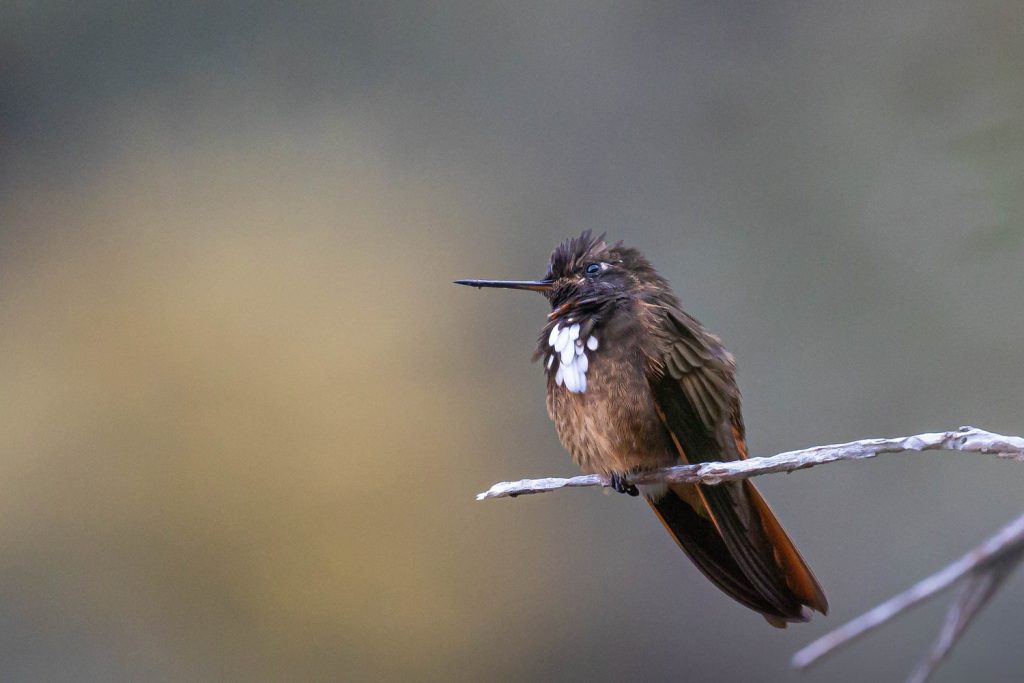
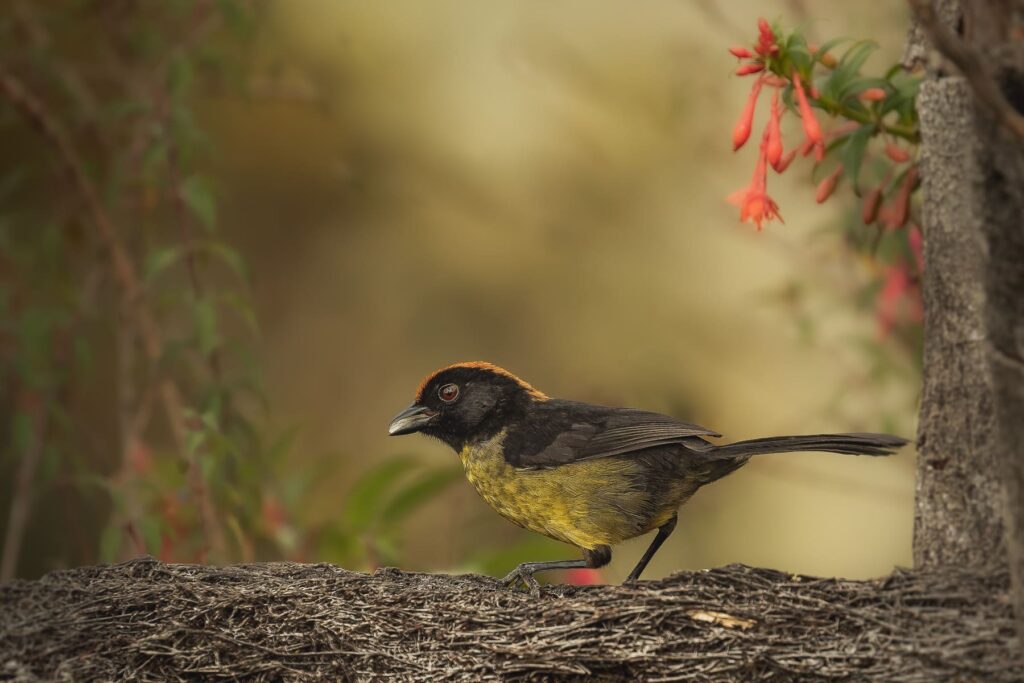
The surrounding slopes produced several characteristic birds of the dry Andes. Bearded Mountaineer was one of the principal specialties, while Rusty-fronted Canastero (E) and Chestnut-breasted Mountain Finch (E) provided two important Peruvian endemics early in the trip.
Other notable species included Cinereous Harrier, Mountain Caracara, Many-colored Rush Tyrant and Wren-like Rushbird.
Paucartambo and the ascent toward Acjanaco
Continuing eastward, we crossed increasingly rural Andean landscapes before reaching Paucartambo. A short stop around town and the river added Torrent Duck, Giant Hummingbird, Black-tailed Trainbearer, White-bellied Woodstar and White-bellied Hummingbird.
Beyond Paucartambo, the road began climbing toward Acjanaco and the humid eastern slope. The change in vegetation became increasingly obvious as the dry inter-Andean landscape gave way to cool montane scrub and eventually forest.
Late-afternoon birding between Acjanaco and Wayqecha produced Marcapata Spinetail (E), Amethyst-throated Sunangel, Violet-throated Starfrontlet, Three-striped Hemispingus, Hooded Mountain Tanager, Scarlet-bellied Mountain Tanager and Chestnut-bellied Mountain Tanager.
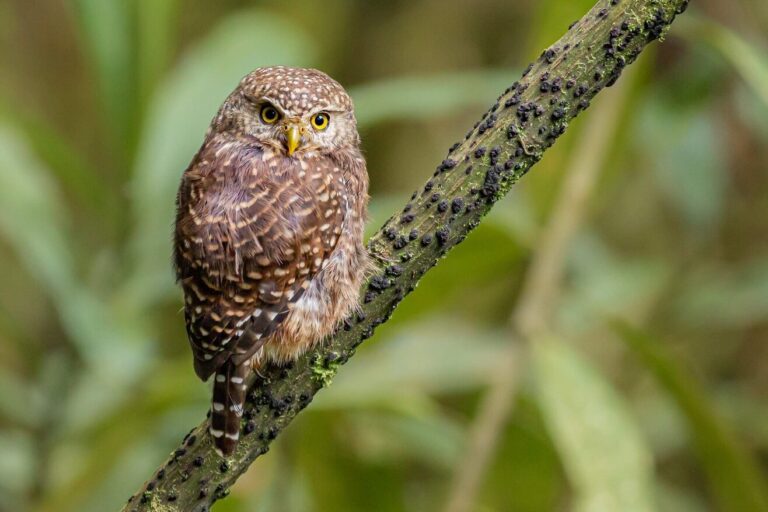
A calling Yungas Pygmy-Owl was another excellent addition before we finished our first day in the upper cloud-forest zone.
Day 2: Wayqecha to the Mid-elevation Cloud Forest
August 18
The second day brought us fully into the humid forests of the eastern Andes, beginning in the cool upper montane zone and progressively descending into taller cloud forest.
Esperanza – Upper Montane and Elfin Forest
We started around Esperanza, where the forest is relatively low and dense, with abundant mosses, epiphytes and patches of bamboo. These upper montane forests support a particularly interesting concentration of localized Andean birds.
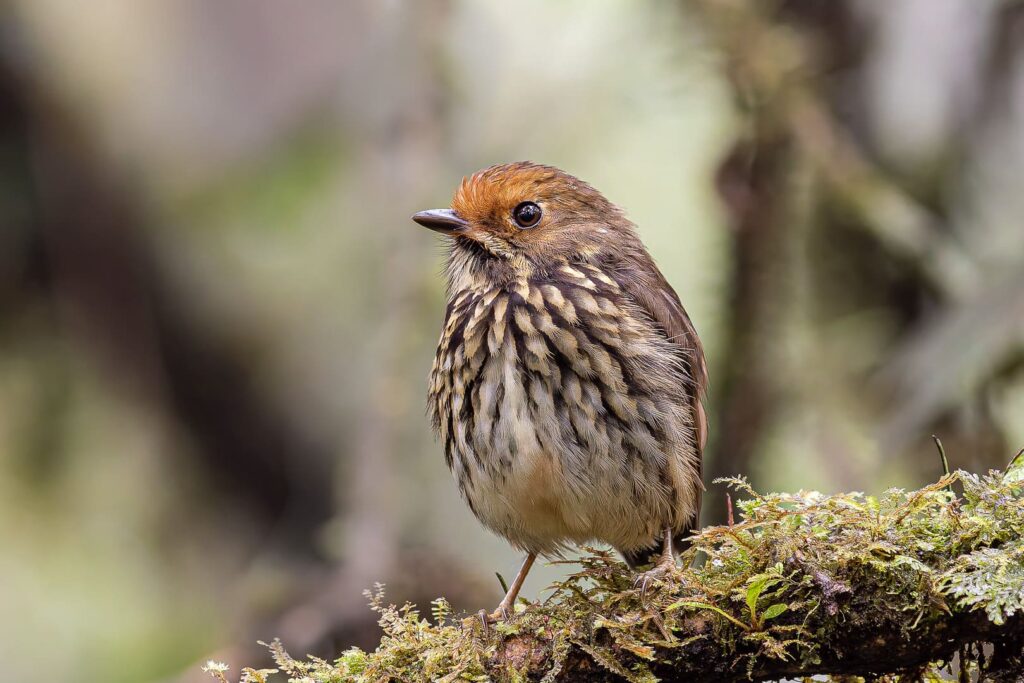
The morning was outstanding for antpittas. We recorded Red-and-white Antpitta (E), Urubamba Antpitta (E) and Leymebamba Antpitta, making this one of the strongest antpitta sessions of the trip.
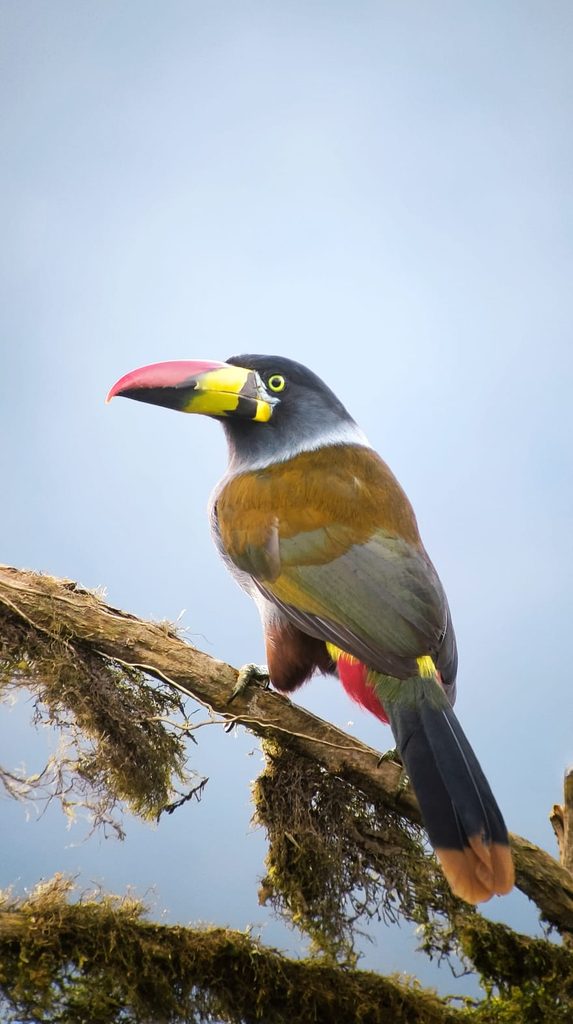
Gray-breasted Mountain-Toucan was another highlight. Large, colorful and unmistakably Andean, this species is one of the characteristic birds of cool montane forest and one of the most impressive toucans found along the Manu Road.
The forest also produced Inca Flycatcher (E), Band-tailed Fruiteater, Barred Fruiteater, Crimson-mantled Woodpecker, Golden-collared Tanager and Grass-green Tanager, together with a varied supporting cast of mountain tanagers, flowerpiercers and forest flycatchers.
Rocotal – Cloud Forest at 2,000–2,200 m
By afternoon we had descended toward Rocotal, where the forest becomes taller, warmer and noticeably more humid.
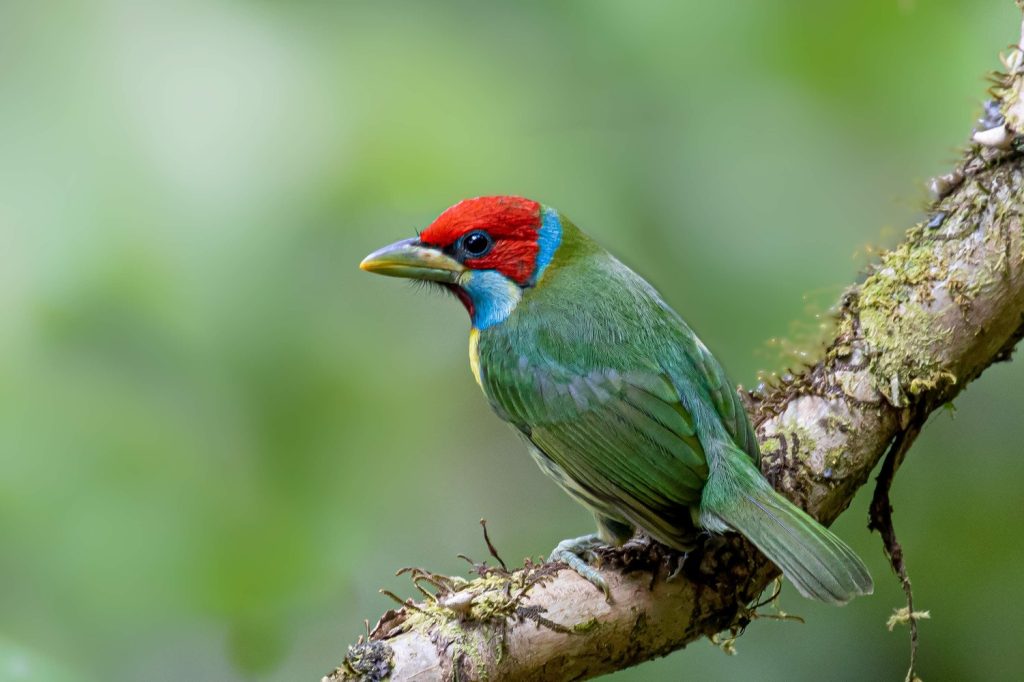
Here we found Crested Quetzal, Blue-banded Toucanet, Chestnut-crested Cotinga, Versicolored Barbet, Bolivian Tyrannulet and Rufous-booted Racket-tail.
Tanagers were particularly well represented, including Yellow-throated Tanager, Beryl-spangled Tanager, Saffron-crowned Tanager, Hooded Mountain Tanager, Blue-capped Tanager and Chestnut-bellied Mountain Tanager.
The difference between the compact upper forest of the morning and the taller cloud forest of Rocotal was already producing a significant turnover in species within a single day.
Day 3: Lower Cloud Forest and the Cock-of-the-Rock Zone
August 19
Our third day took us farther downslope into warmer forest between the lower cloud forest and the upper Amazonian foothills.
Tanager Corner to the Thousand-meter Bridge
We began between roughly 1,100 and 1,300 metres, where the bird community becomes increasingly Amazonian while still retaining some Andean elements.
Hummingbirds were a major feature of the morning, with Wire-crested Thorntail, Violet-fronted Brilliant, Many-spotted Hummingbird and Rufous-booted Racket-tail among those recorded. A Peruvian Piedtail (E) was heard during the session.
One of the most striking birds was Amazonian Umbrellabird. This unusual cotinga is among the most distinctive birds of the foothills, especially the male with its large crest and long, feathered throat ornament.
Other highlights included Golden-headed Quetzal, Bluish-fronted Jacamar, Versicolored Barbet, Cinnamon-faced Tyrannulet and Orange-eared Tanager.
We also recorded our first Andean Cock-of-the-rock of the day.
Cock-of-the-Rock Zone
Later we concentrated on the forest around 1,700–1,800 metres, an important elevation for one of the most emblematic birds of Peru.
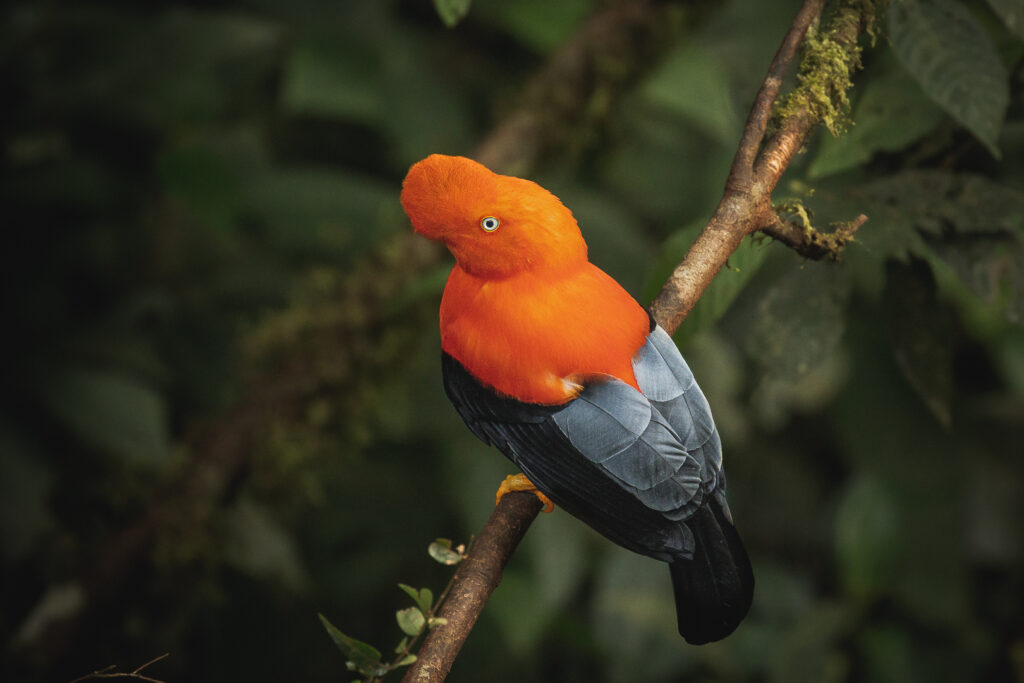
Here we encountered five Andean Cock-of-the-rocks. The species is the national bird of Peru, and adult males are among the most spectacular birds of the Andes, with brilliant orange-red plumage and an extraordinary rounded crest.
Males traditionally gather at display sites known as leks, where several individuals may display in the same area in an effort to attract females.
The same forest also produced Golden-headed Quetzal, Black-streaked Puffbird, Rufescent Screech-Owl and Yungas Pygmy-Owl, ending another excellent day in the cloud forest.
Day 4: Cloud Forest to the Amazonian Foothills
August 20
This was one of the biggest habitat-transition days of the trip. We began in cool montane forest and finished around 600 metres in warm Amazonian foothill habitat.
Manu Cloud Forest Lodge
Morning birding between approximately 1,500 and 1,700 metres produced a rich selection of cloud-forest species.
Among the highlights were Black-streaked Puffbird, Versicolored Barbet, Yungas Manakin, Andean Cock-of-the-rock, Ochre-faced Tody-Flycatcher, Orange-eared Tanager and Golden-naped Tanager.
Mixed-species flocks were an important feature at this elevation. These mobile feeding groups can suddenly fill an otherwise quiet patch of forest with foliage-gleaners, flycatchers, warblers, tanagers and other species moving together through the canopy.
Cock-of-the-Rock Lodge area
Around the lodge gardens and nearby forest we added several additional specialties, including Wire-crested Thorntail, Cerulean-capped Manakin (E), Slaty Gnateater and Yungas Manakin.
Cerulean-capped Manakin is one of the most localized Peruvian endemics accessible along the Manu Road and an important target of this elevation zone.
Manu Endemic Station
Continuing downhill brought us to the hummingbird feeders and surrounding foothill forest at Manu Endemic Station.
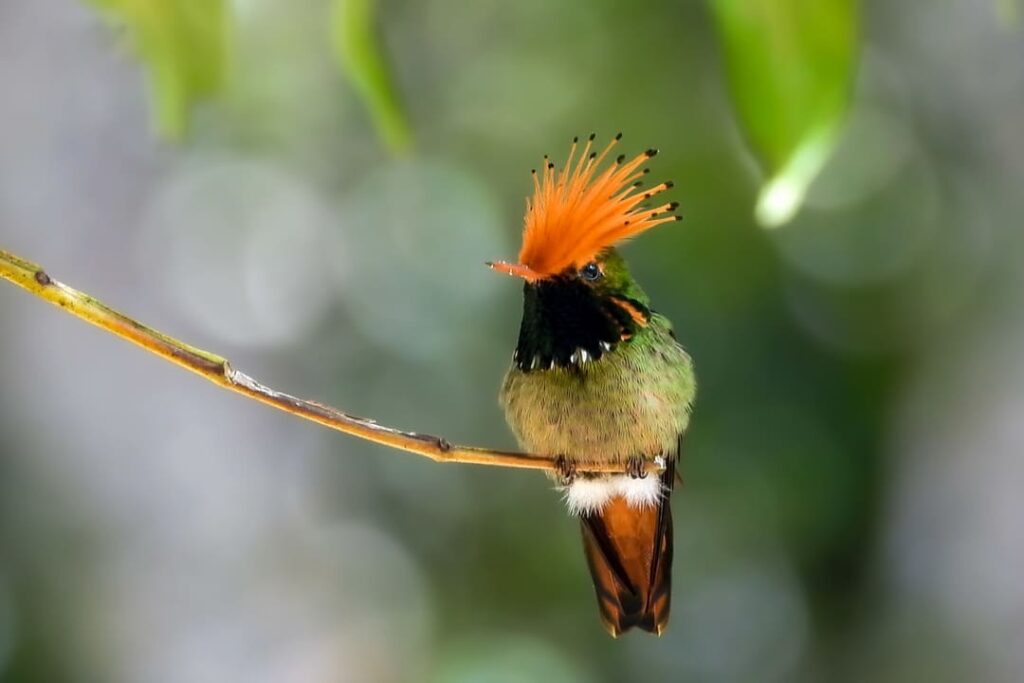
Hummingbird diversity was excellent, with Pale-tailed Barbthroat, Green Hermit, Great-billed Hermit, White-browed Hermit, Rufous-crested Coquette, Peruvian Piedtail (E), Gould’s Jewelfront, Many-spotted Hummingbird and Sapphire-spangled Emerald among those recorded.
The surrounding forest added Amazonian Umbrellabird, Cuzco Warbler and numerous colorful tanagers.
Patria and Manu Biolodge
At approximately 600–900 metres the landscape had become unmistakably Amazonian.
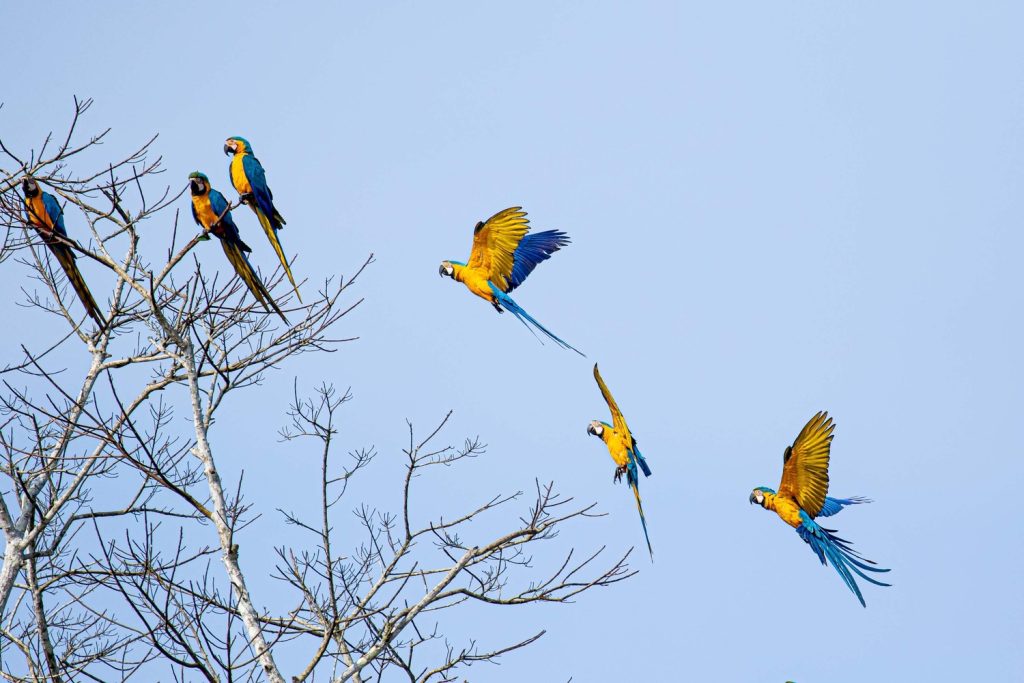
Large parrots became particularly conspicuous, including Red-bellied Macaw, Blue-and-yellow Macaw, Chestnut-fronted Macaw and numerous White-eyed Parakeets.
By late afternoon we reached Manu Biolodge, formerly Villa Carmen. The lodge grounds immediately produced Blue-throated Piping-Guan, Spix’s Guan, Gray-cowled Wood-Rail and Purple Gallinule.
After darkness, Tropical Screech-Owl and Black-banded Owl gave us our first nocturnal birds of the foothills.
Day 5: Manu Biolodge and Inkamazonia
August 21
The fifth day was devoted to the exceptionally diverse foothill habitats around Manu Biolodge, followed by an afternoon visit to Inkamazonia and a productive nocturnal outing.
Manu Biolodge – Foothill Forest and Guadua Bamboo
The morning checklist contained 93 species.
Tinamous were particularly well represented, with Cinereous Tinamou, Little Tinamou, Undulated Tinamou and Black-capped Tinamou all recorded.
One of the most memorable birds was Razor-billed Curassow, a large and impressive forest bird, accompanied by Blue-throated Piping-Guan and Spix’s Guan.
The extensive Guadua bamboo patches around the lodge are especially important. Bamboo forest supports its own specialized bird community, and we encountered species such as Bamboo Antshrike and Chestnut-tailed Antbird.
Other notable birds included Fine-barred Piculet (E), Chestnut-eared Aracari, Black-fronted Nunbird, Swallow-winged Puffbird, Bluish-fronted Jacamar, several macaws and a diverse collection of lowland flycatchers.
The contrast with the cloud forest visited only two days earlier was striking. Mountain-tanagers and cool-climate hummingbirds had been replaced by aracaris, macaws, large guans, antbirds and Amazonian forest species.
Inkamazonia Hummingbird Garden
In the afternoon we visited Inkamazonia, where hummingbird feeders allowed close observation of a good selection of foothill species.
These included White-necked Jacobin, White-bearded Hermit, Rufous-crested Coquette, Gould’s Jewelfront, Blue-tailed Emerald, Gray-breasted Sabrewing, Fork-tailed Woodnymph, Golden-tailed Sapphire and Sapphire-spangled Emerald.
A soaring King Vulture was another excellent highlight.
Owling at Manu Biolodge
After dark we returned to the forest for a short nocturnal session.
In only 45 minutes we recorded Common Pauraque, Common Potoo, Tropical Screech-Owl, Tawny-bellied Screech-Owl and Black-banded Owl.
Five nocturnal species made this one of the most productive evening sessions of the tour.
Day 6: Foothill Forest to the Upper Manu Road
August 22
Today we began retracing the enormous altitudinal gradient toward the Andes, starting once again in warm foothill forest before climbing progressively back into cloud forest.
Pico de Hoz and foothill forest
The morning began around the hummingbird garden and forest at Pico de Hoz.
Highlights included Rufous-breasted Hermit, Long-billed Starthroat, Rufous-crested Coquette, Many-spotted Hummingbird, King Vulture, Great Black Hawk, Blue-crowned Trogon and Fiery-capped Manakin.
Manu Biolodge – Bamboo specialties
Back around Manu Biolodge we concentrated once more on Guadua-dominated forest.
This habitat produced several important bamboo specialists, including Manu Antbird, Goeldi’s Antbird, Bamboo Antshrike, White-lined Antbird, Red-billed Scythebill, Cabanis’s Spinetail and Band-tailed Manakin.
Large Guadua stands are one of the most distinctive habitats of the lower Manu Road. Although they can appear structurally simpler than tall rainforest, they support a surprisingly specialized bird community, with several species closely associated with bamboo.
Return through the cloud forest
As we began climbing, the change in elevation once again brought a rapid turnover in birds.
Around Bambu Lodge we encountered colorful foothill species such as Green-and-gold Tanager, while farther uphill near the Cock-of-the-Rock area we found Golden-headed Quetzal and Andean Motmot.
A particularly memorable afternoon bird was Lyre-tailed Nightjar. Adult males of this remarkable species possess greatly elongated outer tail feathers, making them one of the most spectacular nightjars of the Andes.
Later, after dark around Pillahuata, we added Swallow-tailed Nightjar.
Day 7: Wayqecha, Acjanaco and Return to Cusco
August 23
Our final day began before sunrise in the upper cloud forest and gradually took us back across the Andes toward Cusco.
Wayqecha and the Upper Cloud Forest
Before daylight we encountered Scissor-tailed Nightjar, an excellent start to the final morning.
As the forest brightened, we continued birding toward Acjanaco. Characteristic upper-elevation species included Gray-breasted Mountain-Toucan, Puna Thistletail, Black-throated Tody-Tyrant, Rufous-bellied Bush-Tyrant, Golden-collared Tanager and Chestnut-bellied Mountain Tanager.
The return climb effectively allowed us to experience the Manu Road ecological sequence in reverse. Amazonian foothill forest gave way to cloud forest, cloud forest became elfin woodland, and finally the forest disappeared into exposed high-Andean vegetation.
Acjanaco – High Andes
Near the pass, the landscape opened into puna and high montane scrub.
Birds here included Puna Tapaculo, Creamy-crested Spinetail (E), Great Sapphirewing, Brown-backed Chat-Tyrant, Scarlet-bellied Mountain Tanager and Plain-colored Seedeater.
Only the previous morning we had been surrounded by bamboo antbirds and Amazonian forest species. The ecological contrast could hardly have been greater.
Across the Andes toward Cusco
Our final birding stop returned us to the dry inter-Andean habitats west of the mountains.
Here we again encountered Rusty-fronted Canastero (E) and Chestnut-breasted Mountain Finch (E), together with Peruvian Sierra Finch, Black-throated Flowerpiercer, Band-tailed Seedeater and Golden-billed Saltator.
It was a fitting end to a seven-day journey that had taken us from high-Andean wetlands and dry valleys through puna, elfin forest and cloud forest all the way to the Amazonian foothills—and then back again.
Trip Summary
The Manu Road is exceptional not simply because of the number of birds that can be encountered, but because of the extraordinary diversity of habitats accessible along a single route.
During this trip we experienced high-Andean wetlands, dry inter-Andean valleys, puna, elfin forest, several elevational bands of montane cloud forest, humid foothill forest, extensive Guadua bamboo and Amazonian-edge habitats.
Across the seven days we recorded 332 bird species, after removing the duplicated August 21 checklist and consolidating entries representing subspecies or species groups rather than additional species.
Among the many highlights were Bearded Mountaineer, Red-and-white Antpitta, Urubamba Antpitta, Gray-breasted Mountain-Toucan, Inca Flycatcher, Crested Quetzal, Amazonian Umbrellabird, Andean Cock-of-the-rock, Cerulean-capped Manakin, Peruvian Piedtail, Razor-billed Curassow, Fine-barred Piculet, Manu Antbird, Goeldi’s Antbird, Lyre-tailed Nightjar, Swallow-tailed Nightjar, Scissor-tailed Nightjar and Creamy-crested Spinetail.
More than anything, the trip demonstrated why the eastern slope of the Peruvian Andes is such a remarkable birding destination: within a relatively short distance, completely different ecosystems and bird communities replace one another from the high Andes to the edge of the Amazon.
Species List
TOTAL SPECIES: 322
TINAMOUS
1. Hooded Tinamou — Nothocercus nigrocapillus
2. Brown Tinamou — Crypturellus obsoletus
3. Cinereous Tinamou — Crypturellus cinereus
4. Little Tinamou — Crypturellus soui
5. Undulated Tinamou — Crypturellus undulatus
6. Black-capped Tinamou — Crypturellus atrocapillus
DUCKS & GEESE
7. Puna Teal — Spatula puna
8. Yellow-billed Pintail — Anas georgica
9. Yellow-billed Teal — Anas flavirostris
10. Andean Duck — Oxyura ferruginea
11. Torrent Duck — Merganetta armata
12. Brazilian Teal — Amazonetta brasiliensis
GUANS, CHACHALACAS & CURASSOWS
13. Andean Guan — Penelope montagnii
14. Speckled Chachalaca — Ortalis guttata
15. Blue-throated Piping-Guan — Pipile cumanensis
16. Spix’s Guan — Penelope jacquacu
17. Razor-billed Curassow — Mitu tuberosum
PIGEONS & DOVES
18. Rock Pigeon — Columba livia
19. Spot-winged Pigeon — Patagioenas maculosa
20. Bare-faced Ground Dove — Metriopelia ceciliae
21. Eared Dove — Zenaida auriculata
22. Band-tailed Pigeon — Patagioenas fasciata
23. Plumbeous Pigeon — Patagioenas plumbea
24. Ruddy Pigeon — Patagioenas subvinacea
25. Pale-vented Pigeon — Patagioenas cayennensis
26. Gray-fronted Dove — Leptotila rufaxilla
CUCKOOS
27. Common Squirrel-Cuckoo — Piaya cayana
28. Smooth-billed Ani — Crotophaga ani
NIGHTJARS
29. Common Pauraque — Nyctidromus albicollis
30. Lyre-tailed Nightjar — Uropsalis lyra
31. Swallow-tailed Nightjar — Uropsalis segmentata
32. Scissor-tailed Nightjar — Hydropsalis torquata
POTOOS
33. Common Potoo — Nyctibius griseus
SWIFTS
34. Chestnut-collared Swift — Streptoprocne rutila
35. White-collared Swift — Streptoprocne zonaris
36. Gray-rumped Swift — Chaetura cinereiventris
37. Fork-tailed Palm Swift — Tachornis squamata
HUMMINGBIRDS
38. Sparkling Violetear — Colibri coruscans
39. Black-tailed Trainbearer — Lesbia victoriae
40. Bearded Mountaineer — Oreonympha nobilis
41. Giant Hummingbird — Patagona gigas
42. White-bellied Woodstar — Chaetocercus mulsant
43. White-bellied Hummingbird — Elliotomyia chionogaster
44. Amethyst-throated Sunangel — Heliangelus amethysticollis
45. Tyrian Metaltail — Metallura tyrianthina
46. Shining Sunbeam — Aglaeactis cupripennis
47. Violet-throated Starfrontlet — Coeligena violifer
48. Speckled Hummingbird — Adelomyia melanogenys
49. Rufous-booted Racket-tail — Ocreatus addae
50. Wire-crested Thorntail — Discosura popelairii
51. Peruvian Piedtail — Phlogophilus harterti
52. Violet-fronted Brilliant — Heliodoxa leadbeateri
53. Fork-tailed Woodnymph — Thalurania furcata
54. Many-spotted Hummingbird — Taphrospilus hypostictus
55. Lesser Violetear — Colibri cyanotus
56. White-necked Jacobin — Florisuga mellivora
57. Pale-tailed Barbthroat — Threnetes leucurus
58. Green Hermit — Phaethornis guy
59. Great-billed Hermit — Phaethornis malaris
60. White-browed Hermit — Phaethornis stuarti
61. Rufous-crested Coquette — Lophornis delattrei
62. Gould’s Jewelfront — Heliodoxa aurescens
63. Gray-breasted Sabrewing — Campylopterus largipennis
64. Sapphire-spangled Emerald — Chionomesa lactea
65. Golden-tailed Sapphire — Chrysuronia oenone
66. White-bearded Hermit — Phaethornis hispidus
67. Blue-tailed Emerald — Chlorostilbon mellisugus
68. Rufous-breasted Hermit — Glaucis hirsutus
69. Long-billed Starthroat — Heliomaster longirostris
70. Reddish Hermit — Phaethornis ruber
71. Great Sapphirewing — Pterophanes cyanopterus
RAILS, GALLINULES & COOTS
72. Plumbeous Rail — Pardirallus sanguinolentus
73. Common Gallinule — Gallinula galeata
74. Slate-colored Coot — Fulica ardesiaca
75. Gray-cowled Wood-Rail — Aramides cajaneus
76. Purple Gallinule — Porphyrio martinica
77. Rufous-sided Crake — Laterallus melanophaius
LIMPKIN
78. Limpkin — Aramus guarauna
HOATZIN
79. Hoatzin — Opisthocomus hoazin
PLOVERS
80. Andean Lapwing — Vanellus resplendens
GULLS
81. Andean Gull — Chroicocephalus serranus
FLAMINGOS
82. Chilean Flamingo — Phoenicopterus chilensis
GREBES
83. White-tufted Grebe — Rollandia rolland
CORMORANTS
84. Neotropic Cormorant — Nannopterum brasilianum
IBISES
85. Puna Ibis — Plegadis ridgwayi
HERONS & EGRETS
86. Snowy Egret — Egretta thula
87. Western Cattle-Egret — Ardea ibis
88. Capped Heron — Pilherodius pileatus
89. Striated Heron — Butorides striata
90. Great Egret — Ardea alba
91. Rufescent Tiger-Heron — Tigrisoma lineatum
NEW WORLD VULTURES
92. Turkey Vulture — Cathartes aura
93. Black Vulture — Coragyps atratus
94. Greater Yellow-headed Vulture — Cathartes melambrotus
95. King Vulture — Sarcoramphus papa
HAWKS, KITES & EAGLES
96. Cinereous Harrier — Circus cinereus
97. Variable Hawk — Geranoaetus polyosoma
98. Plumbeous Kite — Ictinia plumbea
99. Swallow-tailed Kite — Elanoides forficatus
100. Sharp-shinned Hawk — Accipiter striatus
101. Roadside Hawk — Rupornis magnirostris
102. Great Black Hawk — Buteogallus urubitinga
OWLS
103. Yungas Pygmy-Owl — Glaucidium bolivianum
104. Rufescent Screech-Owl — Megascops ingens
105. Tropical Screech-Owl — Megascops choliba
106. Black-banded Owl — Strix huhula
107. Tawny-bellied Screech-Owl — Megascops watsonii
TROGONS & QUETZALS
108. Masked Trogon — Trogon personatus
109. Crested Quetzal — Pharomachrus antisianus
110. Golden-headed Quetzal — Pharomachrus auriceps
111. Black-tailed Trogon — Trogon melanurus
112. Blue-crowned Trogon — Trogon curucui
MOTMOTS
113. Andean Motmot — Momotus aequatorialis
KINGFISHERS
114. Green Kingfisher — Chloroceryle americana
JACAMARS
115. Bluish-fronted Jacamar — Galbula cyanescens
PUFFBIRDS & NUNBIRDS
116. Black-streaked Puffbird — Malacoptila fulvogularis
117. Black-fronted Nunbird — Monasa nigrifrons
118. Swallow-winged Puffbird — Chelidoptera tenebrosa
BARBETS
119. Versicolored Barbet — Eubucco versicolor
TOUCANS
120. Gray-breasted Mountain-Toucan — Andigena hypoglauca
121. Blue-banded Toucanet — Aulacorhynchus coeruleicinctis
122. Chestnut-eared Aracari — Pteroglossus castanotis
WOODPECKERS
123. Crimson-mantled Woodpecker — Colaptes rivolii
124. Golden-olive Woodpecker — Colaptes rubiginosus
125. Fine-barred Piculet — Picumnus subtilis
126. Yellow-tufted Woodpecker — Melanerpes cruentatus
127. Cream-colored Woodpecker — Celeus flavus
FALCONS & CARACARAS
128. Mountain Caracara — Daptrius megalopterus
129. American Kestrel — Falco sparverius
130. Barred Forest-Falcon — Micrastur ruficollis
PARROTS & MACAWS
131. Scaly-naped Amazon — Amazona mercenarius
132. Speckle-faced Parrot — Pionus tumultuosus
133. White-eyed Parakeet — Psittacara leucophthalmus
134. Blue-headed Parrot — Pionus menstruus
135. Red-bellied Macaw — Orthopsittaca manilatus
136. Blue-and-yellow Macaw — Ara ararauna
137. Chestnut-fronted Macaw — Ara severus
138. Dusky-headed Parakeet — Aratinga weddellii
139. Military Macaw — Ara militaris
140. Red-and-green Macaw — Ara chloropterus
ANTSHRIKES & ANTWRENS
141. Bamboo Antshrike — Cymbilaimus sanctaemariae
142. Great Antshrike — Taraba major
143. Stripe-chested Antwren — Myrmotherula longicauda
144. Yellow-breasted Antwren — Herpsilochmus axillaris
145. Dot-winged Antwren — Microrhopias quixensis
ANTBIRDS
146. Yellow-breasted Warbling-Antbird — Hypocnemis subflava
147. Chestnut-tailed Antbird — Sciaphylax hemimelaena
148. White-browed Antbird — Myrmoborus leucophrys
149. White-lined Antbird — Myrmoborus lophotes
150. Manu Antbird — Cercomacra manu
151. Goeldi’s Antbird — Akletos goeldii
GNATEATERS
152. Slaty Gnateater — Conopophaga ardesiaca
ANTPITTAS
153. Red-and-white Antpitta — Grallaria erythroleuca
154. Urubamba Antpitta — Grallaria occabambae
155. Leymebamba Antpitta — Grallaricula leymebambae
TAPACULOS
156. Trilling Tapaculo — Scytalopus parvirostris
157. White-crowned Tapaculo — Scytalopus atratus
158. Puna Tapaculo — Scytalopus simonsi
WOODCREEPERS
159. Montane Woodcreeper — Lepidocolaptes lacrymiger
160. Olive-backed Woodcreeper — Xiphorhynchus triangularis
161. Red-billed Scythebill — Campylorhamphus trochilirostris
OVENBIRDS
162. Wren-like Rushbird — Phleocryptes melanops
163. Rusty-fronted Canastero — Asthenes ottonis
164. Marcapata Spinetail — Cranioleuca marcapatae
165. Pearled Treerunner — Margarornis squamiger
166. Azara’s Spinetail — Synallaxis azarae
167. Montane Foliage-gleaner — Anabacerthia striaticollis
168. Plain-crowned Spinetail — Synallaxis gujanensis
169. Dusky-cheeked Foliage-gleaner — Anabazenops dorsalis
170. Cabanis’s Spinetail — Synallaxis cabanisi
171. Puna Thistletail — Asthenes helleri
172. Creamy-crested Spinetail — Cranioleuca albicapilla
COTINGAS & FRUITEATERS
173. Band-tailed Fruiteater — Pipreola intermedia
174. Barred Fruiteater — Pipreola arcuata
175. Red-crested Cotinga — Ampelion rubrocristatus
176. Chestnut-crested Cotinga — Ampelion rufaxilla
177. Andean Cock-of-the-rock — Rupicola peruvianus
178. Amazonian Umbrellabird — Cephalopterus ornatus
MANAKINS
179. Yungas Manakin — Chiroxiphia boliviana
180. Cerulean-capped Manakin — Lepidothrix coeruleocapilla
181. Fiery-capped Manakin — Machaeropterus pyrocephalus
182. Band-tailed Manakin — Pipra fasciicauda
TITYRAS & BECARDS
183. Barred Becard — Pachyramphus versicolor
184. Masked Tityra — Tityra semifasciata
185. White-winged Becard — Pachyramphus polychopterus
TYRANT FLYCATCHERS
186. Many-colored Rush Tyrant — Tachuris rubrigastra
187. Spot-billed Ground-Tyrant — Muscisaxicola maculirostris
188. White-banded Tyrannulet — Mecocerculus stictopterus
189. White-throated Tyrannulet — Mecocerculus leucophrys
190. Inca Flycatcher — Leptopogon taczanowskii
191. Cinnamon Flycatcher — Pyrrhomyias cinnamomeus
192. Sierran Elaenia — Elaenia pallatangae
193. Smoke-colored Pewee — Contopus fumigatus
194. Maroon-belted Chat-Tyrant — Ochthoeca thoracica
195. Rufous-breasted Chat-Tyrant — Ochthoeca rufipectoralis
196. Red-rumped Bush-Tyrant — Cnemarchus erythropygius
197. Golden-crowned Flycatcher — Myiodynastes chrysocephalus
198. Tropical Kingbird — Tyrannus melancholicus
199. Bolivian Tyrannulet — Zimmerius bolivianus
200. Black Phoebe — Sayornis nigricans
201. Cinnamon-faced Tyrannulet — Phylloscartes parkeri
202. Mottle-backed Elaenia — Elaenia gigas
203. Lemon-browed Flycatcher — Conopias cinchoneti
204. Slaty-capped Flycatcher — Leptopogon superciliaris
205. Scale-crested Pygmy-Tyrant — Lophotriccus pileatus
206. Ochre-faced Tody-Flycatcher — Poecilotriccus plumbeiceps
207. Torrent Tyrannulet — Serpophaga cinerea
208. Streaked Flycatcher — Myiodynastes maculatus
209. Great Kiskadee — Pitangus sulphuratus
210. Boat-billed Flycatcher — Megarynchus pitangua
211. Social Flycatcher — Myiozetetes similis
212. Black-backed Tody-Flycatcher — Poecilotriccus pulchellus
213. Long-tailed Tyrant — Colonia colonus
214. Gray-capped Flycatcher — Myiozetetes granadensis
215. Short-tailed Pygmy-Tyrant — Myiornis ecaudatus
216. Rusty-fronted Tody-Flycatcher — Poecilotriccus latirostris
217. Gray-crowned Flatbill — Tolmomyias poliocephalus
218. Short-crested Flycatcher — Myiarchus ferox
219. Piratic Flycatcher — Legatus leucophaius
220. Crowned Slaty Flycatcher — Empidonomus aurantioatrocristatus
221. Sepia-capped Flycatcher — Leptopogon amaurocephalus
222. Olive-faced Flatbill — Tolmomyias viridiceps
223. White-cheeked Tody-Flycatcher — Poecilotriccus albifacies
224. Streak-necked Flycatcher — Mionectes striaticollis
225. Black-throated Tody-Tyrant — Hemitriccus granadensis
226. Rufous-bellied Bush-Tyrant — Myiotheretes fuscorufus
227. Brown-backed Chat-Tyrant — Ochthoeca fumicolor
228. Yellow-billed Tit-Tyrant — Anairetes flavirostris
VIREOS
229. Brown-capped Vireo — Vireo leucophrys
230. Chivi Vireo — Vireo chivi
JAYS
231. White-collared Jay — Cyanolyca viridicyanus
232. Violaceous Jay — Cyanocorax violaceus
233. Purplish Jay — Cyanocorax cyanomelas
SWALLOWS
234. Brown-bellied Swallow — Orochelidon murina
235. Blue-and-white Swallow — Pygochelidon cyanoleuca
236. Pale-footed Swallow — Orochelidon flavipes
237. Southern Rough-winged Swallow — Stelgidopteryx ruficollis
238. White-winged Swallow — Tachycineta albiventer
239. White-banded Swallow — Atticora fasciata
WRENS
240. Southern House Wren — Troglodytes musculus
241. Mountain Wren — Troglodytes solstitialis
242. Gray-breasted Wood-Wren — Henicorhina leucophrys
243. Moustached Wren — Pheugopedius genibarbis
DONACOBIUS
244. Black-capped Donacobius — Donacobius atricapilla
THRUSHES & SOLITAIRES
245. Chiguanco Thrush — Turdus chiguanco
246. Glossy-black Thrush — Turdus serranus
247. Andean Solitaire — Myadestes ralloides
248. White-eared Solitaire — Entomodestes leucotis
249. Great Thrush — Turdus fuscater
250. Speckled Nightingale-Thrush — Catharus maculatus
251. Black-billed Thrush — Turdus ignobilis
FINCHES & EUPHONIAS
252. Hooded Siskin — Spinus magellanicus
253. Orange-bellied Euphonia — Euphonia xanthogaster
254. Olivaceous Siskin — Spinus olivaceus
255. Blue-naped Chlorophonia — Chlorophonia cyanea
256. Golden-bellied Euphonia — Euphonia chrysopasta
257. Rufous-bellied Euphonia — Euphonia rufiventris
NEW WORLD SPARROWS & CHLOROSPINGUS
258. Rufous-collared Sparrow — Zonotrichia capensis
259. Short-billed Chlorospingus — Chlorospingus parvirostris
260. Black-faced Brushfinch — Atlapetes melanolaemus
261. Yellow-throated Chlorospingus — Chlorospingus flavigularis
262. Common Chlorospingus — Chlorospingus flavopectus
263. Yellow-browed Sparrow — Ammodramus aurifrons
BLACKBIRDS & OROPENDOLAS
264. Yellow-winged Blackbird — Agelasticus thilius
265. Mountain Cacique — Cacicus chrysonotus
266. Russet-backed Oropendola — Psarocolius angustifrons
267. Dusky-green Oropendola — Psarocolius atrovirens
268. Yellow-rumped Cacique — Cacicus cela
269. Crested Oropendola — Psarocolius decumanus
270. Orange-backed Troupial — Icterus croconotus
WOOD-WARBLERS
271. Citrine Warbler — Myiothlypis luteoviridis
272. Slate-throated Redstart — Myioborus miniatus
273. Spectacled Redstart — Myioborus melanocephalus
274. Pale-legged Warbler — Myiothlypis signata
275. Two-banded Warbler — Myiothlypis bivittata
276. Tropical Parula — Setophaga pitiayumi
277. Russet-crowned Warbler — Myiothlypis coronata
278. Cuzco Warbler — Myiothlypis chrysogaster
CARDINALS & ALLIES
279. Black-backed Grosbeak — Pheucticus aureoventris
TANAGERS & ALLIES
280. Blue-and-yellow Tanager — Rauenia bonariensis
281. Cinereous Conebill — Conirostrum cinereum
282. Black-throated Flowerpiercer — Diglossa brunneiventris
283. Chestnut-breasted Mountain Finch — Poospizopsis caesar
284. Band-tailed Seedeater — Catamenia analis
285. Golden-billed Saltator — Saltator aurantiirostris
286. Rust-and-yellow Tanager — Thlypopsis ruficeps
287. Three-striped Hemispingus — Microspingus trifasciatus
288. Hooded Mountain Tanager — Buthraupis montana
289. Blue-capped Tanager — Sporathraupis cyanocephala
290. Scarlet-bellied Mountain Tanager — Anisognathus igniventris
291. Chestnut-bellied Mountain Tanager — Dubusia castaneoventris
292. White-browed Conebill — Conirostrum ferrugineiventre
293. Moustached Flowerpiercer — Diglossa mystacalis
294. Superciliaried Hemispingus — Thlypopsis superciliaris
295. Grass-green Tanager — Chlorornis riefferii
296. Golden-collared Tanager — Iridosornis jelskii
297. Blue-and-black Tanager — Tangara vassorii
298. Capped Conebill — Conirostrum albifrons
299. Masked Flowerpiercer — Diglossa cyanea
300. Slaty Tanager — Creurgops dentatus
301. Silver-beaked Tanager — Ramphocelus carbo
302. Yellow-throated Tanager — Iridosornis analis
303. Blue-gray Tanager — Thraupis episcopus
304. Blue-necked Tanager — Stilpnia cyanicollis
305. Beryl-spangled Tanager — Tangara nigroviridis
306. Saffron-crowned Tanager — Tangara xanthocephala
307. Deep-blue Flowerpiercer — Diglossa glauca
308. Buff-throated Saltator — Saltator maximus
309. Orange-eared Tanager — Chlorochrysa calliparaea
310. Spotted Tanager — Ixothraupis punctata
311. Paradise Tanager — Tangara chilensis
312. Bay-headed Tanager — Tangara gyrola
313. Golden-eared Tanager — Tangara chrysotis
314. Golden Tanager — Tangara arthus
315. Swallow Tanager — Tersina viridis
316. Golden-naped Tanager — Chalcothraupis ruficervix
317. Bananaquit — Coereba flaveola
318. Palm Tanager — Thraupis palmarum
319. Blue Dacnis — Dacnis cayana
320. Red-capped Cardinal — Paroaria gularis
321. Turquoise Tanager — Tangara mexicana
322. Chestnut-bellied Seed-Finch — Sporophila angolensis
323. Yellow-bellied Tanager — Ixothraupis xanthogastra
324. Yellow-bellied Dacnis — Dacnis flaviventer
325. Purple Honeycreeper — Cyanerpes caeruleus
326. Green Honeycreeper — Chlorophanes spiza
327. Bluish-gray Saltator — Saltator coerulescens
328. Magpie Tanager — Cissopis leverianus
329. Green-and-gold Tanager — Tangara schrankii
330. Drab Hemispingus — Pseudospingus xanthophthalmus
331. Plain-colored Seedeater — Catamenia inornata
332. Peruvian Sierra Finch — Phrygilus punensis
TOTAL: 332 SPECIES
PERUVIAN ENDEMICS: 10
(E) indicates species endemic to Peru. The endemic designation is applied at the species level, not to species for which only the subspecies observed is endemic.
If you want to know some basic tipping guideliness during Birding and Photography Tours, see here.
If you are more interested in a Birding and Cultural Trip see here.