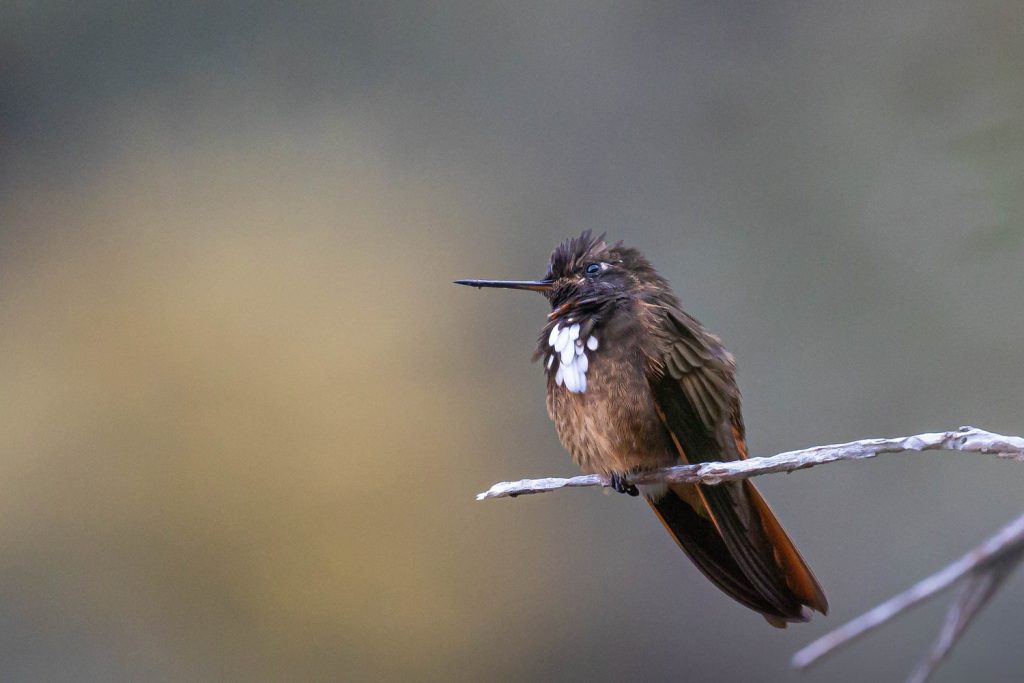
High in the Andean cloud forests of northern Peru resides one of the world’s most extraordinary hummingbirds: the Marvelous Spatuletail (Loddigesia mirabilis). Endemic to this region, this remarkable bird captivates birdwatchers and researchers alike with its unique appearance and behaviors. Despite its beauty, the species faces significant challenges, making its conservation a top priority since it is listed as Endangered .
Characteristic Features
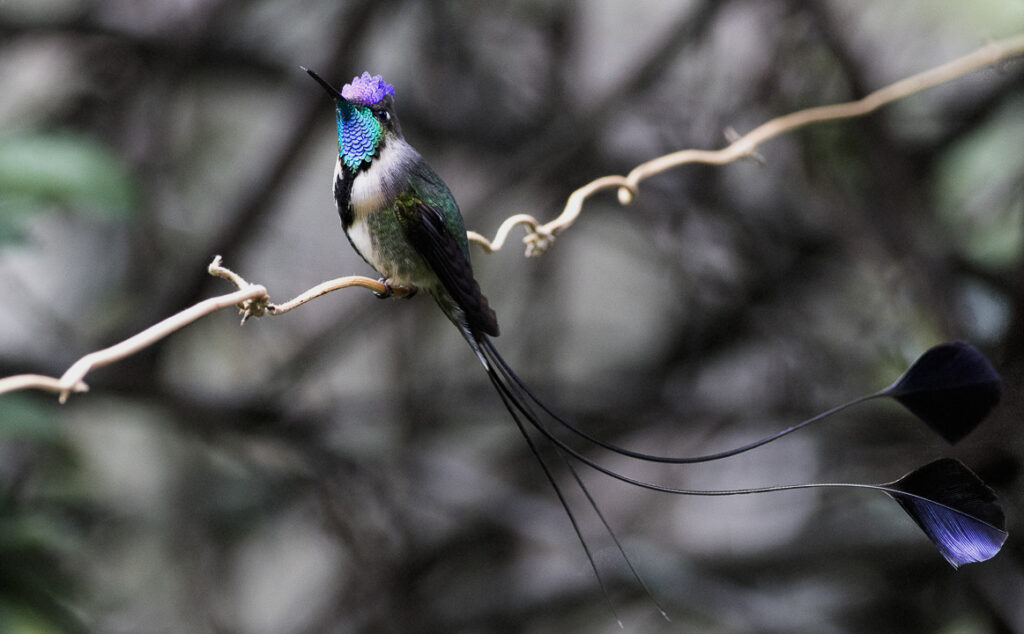
The Marvelous Spatuletail is renowned for its elegant and unusual tail feathers, especially in males. These feathers, reduced to elongated shafts, terminate in dark purple-black spatules that curve and cross each other in flight. The male’s plumage includes a blue crest, green upperparts, a white underside with a black central line, and a shimmering blue-green gorget. Females, while lacking the crest and spatules, exhibit a more subdued but still striking appearance with elongated tails and whitish underparts.
Juveniles resemble females, though young males show signs of their future splendor with partially developed gorgets and small blackish spatules. Measuring about 15–17 cm in males (including the tail) and 9–10 cm in females, this hummingbird is surprisingly lightweight, tipping the scales at only 3 grams—less than a single sheet of paper.
See more information here.
Where to watch the Marvelous Spatuletail Hummingbird
For bird enthusiasts eager to observe this rare hummingbird, the Huembo Lodge and the village of Cochachimba are prime destinations. Located near the town of Pomacochas in the Amazonas region, Huembo Lodge is renowned for its hummingbird feeders that attract the Marvelous Spatuletail, offering visitors an exceptional opportunity to view and photograph this species up close.
Cochachimba, situated near the spectacular Gocta Waterfall, also provides sightings of the Marvelous Spatuletail. The area’s rich biodiversity and conservation efforts have made it a haven for birdwatchers. Both locations not only offer the chance to see the Spatuletail but also support conservation initiatives aimed at preserving its habitat.
These following tours go to visit this places:
- Birding in Northern Peru: The Grand Tour
- Birding in Northern Peru: The Classic Tour
Habitat and Behavior
This species inhabits the humid montane scrub, forest edges, and second-growth vegetation at altitudes of 2,100 to 2,900 meters. In these environments, the Marvelous Spatuletail is often seen feeding on nectar from flowers such as the red-flowered lily (Alstroemeria formosissima) or other species like Rubus and Staureja sericea. Unlike many hummingbirds, it prefers to perch while feeding rather than hover.
Males are particularly known for their elaborate courtship displays, which involve intricate aerial maneuvers and vocalizations to impress potential mates. However, the male-to-female ratio appears imbalanced, with far fewer adult males observed compared to females and juveniles.

Unique Sounds and Vocalizations
The Marvelous Spatuletail’s vocal repertoire adds to its mystique. During courtship displays, males emit a high-pitched, metallic buzzing note that sounds like static electricity, repeated in rhythmic intervals: “tzzz…tzzz…”. Additionally, their calls include a sweet, high-pitched “tswee” delivered rapidly in series and a sharper “tsik” used for communication.

Conservation: A Race Against Time
Listed as Endangered by BirdLife International, the Marvelous Spatuletail faces numerous threats. Its range is restricted to a small area along the eastern slopes of the Andes, primarily near the Utcubamba River in Amazonas, with some sightings in San Martín. The total range covers only about 2,000–3,000 square kilometers, and the population is believed to be very small, with adult males particularly scarce.
The destruction of its habitat—caused by slash-and-burn agriculture, cattle grazing, and firewood harvesting—poses the most immediate threat to the species. Alarmingly, no protected areas currently exist within its range, making habitat preservation an urgent necessity.
A Fragile Gem of Peru
The Marvelous Spatuletail is not only a marvel of nature but also a symbol of Peru’s rich biodiversity. Its shimmering plumage, graceful movements, and fascinating behaviors highlight the need for conservation efforts to protect this rare hummingbird and its delicate montane environment. By preserving its habitat, we safeguard not only the future of this species but also the broader ecological treasures of the Andean cloud forests.