Date: July 10, 2026
Trip type: Birding and Culture
Route: Ollantaytambo – Cusco – Ollantaytambo
Introduction
Machu Picchu is best known as one of the world’s great archaeological destinations, but its setting also places it within an exceptionally interesting natural environment. The sanctuary lies where the eastern Andes fall steeply toward the Amazon Basin, surrounded by humid montane forest, bamboo, rocky slopes and the deeply incised Urubamba Valley.
This was primarily a cultural day, designed around a complete visit to Machu Picchu via Circuit 2, while taking advantage of the early morning and the natural vegetation around Aguas Calientes and the sanctuary to add a birding element. Rather than trying to turn the visit into an intensive birding day, the aim was to enjoy the landscape, archaeology and history of Machu Picchu while remaining alert for some of the characteristic birds of the Urubamba Valley.
The result was an excellent combination. The journey along the river produced the unmistakable Torrent Duck, the vegetation around Aguas Calientes held a surprisingly diverse assemblage of hummingbirds, tanagers and forest birds, and the archaeological sanctuary itself delivered the most important avian target of the day: Inca Wren, encountered shortly after entering Machu Picchu.
TRIP REPORT
Ollantaytambo to Machu Picchu
We left Ollantaytambo at around 6:00 a.m. for the early train to Aguas Calientes. Even before reaching Machu Picchu, the journey itself provided an excellent introduction to the geography of the region.
The railway follows the Urubamba River as it cuts through increasingly steep mountains toward the sanctuary. During the first part of the journey, birding was naturally opportunistic from the train, but the river produced one of the most characteristic birds of the entire valley almost immediately. Several Torrent Ducks were feeding and resting among the fast-flowing sections of the Urubamba, eventually totaling nine during the day’s train journeys.
Other birds along the river included Black Phoebe, a characteristic inhabitant of rocky Andean waterways, together with Andean Gull, Neotropic Cormorant and an Andean Motmot as the vegetation became increasingly humid toward Aguas Calientes.
Early morning birding in Aguas Calientes
After arriving in Aguas Calientes, we used the early morning for birding before heading up to the archaeological sanctuary.
The lush vegetation surrounding the town is very different from the drier inter-Andean landscapes around Ollantaytambo. Here, humid montane forest descends almost to the Urubamba River, with dense secondary vegetation, flowering shrubs and forest-covered slopes providing excellent habitat around the edge of town.
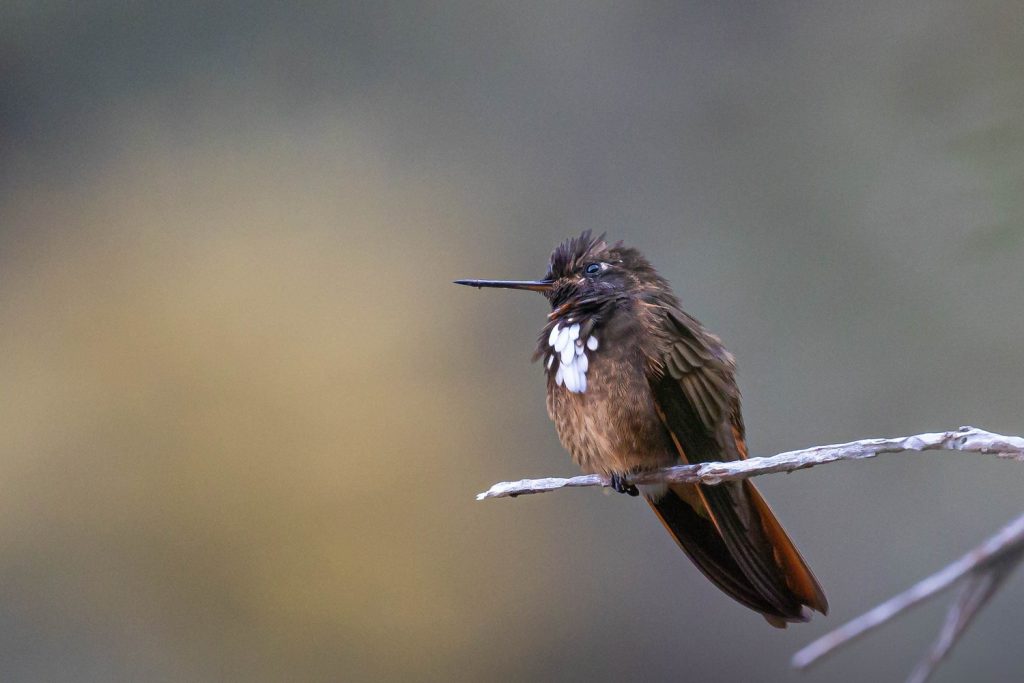
Hummingbirds featured prominently. We found the endemic Green-and-white Hummingbird(E), one of the characteristic birds in Machupicchu but very rare elsewhere, together with a female Rufous-booted Racket-tail and Bronzy Inca.
A pair of Versicolored Barbets was another particularly attractive find, while the forest edge produced Sclater’s Tyrannulet, Torrent Tyrannulet, Variable Antshrike and Streaked Xenops.
Several species were detected by voice from the surrounding vegetation, including Andean Solitaire and Grey-breasted Wood-Wren.
The tanager assemblage was especially colorful. Golden-naped Tanager, Saffron-crowned Tanager, Rust-and-yellow Tanager, Masked Flowerpiercer and numerous Blue-grey Tanagers were among the birds seen before we turned our attention toward the main purpose of the day.
Machu Picchu Sanctuary – Circuit 2
At around 10:00 a.m. we entered the Machu Picchu Historical Sanctuary for Circuit 2.
From the entrance, the setting is immediately extraordinary. Steep forested mountains rise on every side while the Urubamba River loops far below the ruins. The archaeological complex sits dramatically between Machu Picchu Mountain and Huayna Picchu, with terraces, temples, residential sectors and ceremonial structures occupying a narrow mountain ridge.
The visit was principally cultural, allowing time to appreciate the architecture, engineering and extraordinary relationship between the Inca city and its surrounding landscape. Circuit 2 provided the classic perspective over the archaeological complex before continuing through the principal sectors of the site.
Birding remained secondary, but one species deserved special attention.
Almost immediately after entering the sanctuary, suitable bamboo near the entrance produced Inca Wren, the principal bird target for Machu Picchu. One bird was located in the bamboo and gave us the encounter we had hoped for before continuing with the archaeological visit.
The open sky above the ruins held White-tipped Swifts and numerous Blue-and-white Swallows, while an American Kestrel was also seen around the sanctuary. Rufous-collared Sparrows were conspicuous around the open grassy areas, and a White-lined Tanager added another forest-edge species to the list.
There is something particularly memorable about seeing the endemic Inca Wren (E). It is a bird closely associated with the humid bamboo-dominated forests of the region, and finding it among the vegetation surrounding one of the most famous Inca sites in the world perfectly captured the birding-and-culture character of the day.
By around midday we completed the main archaeological visit and descended again toward Aguas Calientes.
Return to Ollantaytambo
Back in Aguas Calientes, there was still time to notice additional birds around the town and surrounding vegetation before taking the afternoon train.
Later observations included Chestnut-breasted Coronet, Sparkling Violetear, Common Tody-Flycatcher, Blue-naped Chlorophonia, Hepatic Tanager, Blue Dacnis and Silver-backed Tanager.
The return railway journey once again followed the Urubamba upstream toward the Sacred Valley, giving further views of Torrent Ducks, Andean Gulls, Black Phoebes and the dramatic river gorge.
We arrived back in Ollantaytambo in the late afternoon, completing a day that had achieved exactly what was intended: a proper cultural experience at Machu Picchu, complemented by relaxed but productive birding in one of the most spectacular landscapes of southern Peru.
Bird List – July 10, 2026
DUCKS
1. Torrent Duck — Merganetta armata
PIGEONS & DOVES
2. Rock Dove — Columba livia
SWIFTS
3. White-tipped Swift — Aeronautes montivagus
HUMMINGBIRDS
4. Sparkling Violetear — Colibri coruscans
5. Bronzy Inca — Coeligena coeligena
6. Chestnut-breasted Coronet — Boissonneaua matthewsii
7. Rufous-booted Racket-tail — Ocreatus addae
8. Green-and-white Hummingbird (E) — Elliotomyia viridicauda
GULLS
9. Andean Gull — Chroicocephalus serranus
CORMORANTS
10. Neotropic Cormorant — Nannopterum brasilianum
FALCONS
11. American Kestrel — Falco sparverius
MOTMOTS
12. Andean Motmot — Momotus aequatorialis
BARBETS
13. Versicolored Barbet — Eubucco versicolor
ANTSHRIKES
14. Variable Antshrike — Thamnophilus caerulescens
OVENBIRDS
15. Streaked Xenops — Xenops rutilans
TYRANT FLYCATCHERS
16. Common Tody-Flycatcher — Todirostrum cinereum
17. Sclater’s Tyrannulet — Phyllomyias sclateri
18. Torrent Tyrannulet — Serpophaga cinerea
19. Tropical Kingbird — Tyrannus melancholicus
20. Black Phoebe — Sayornis nigricans
VIREOS
21. Brown-capped Vireo — Vireo leucophrys
SWALLOWS
22. Blue-and-white Swallow — Pygochelidon cyanoleuca
WRENS
23. Inca Wren (E) — Pheugopedius eisenmanni
24. Grey-breasted Wood-Wren — Henicorhina leucophrys
THRUSHES
25. Andean Solitaire — Myadestes ralloides
FINCHES & EUPHONIAS
26. Blue-naped Chlorophonia — Chlorophonia cyanea
27. Thick-billed Euphonia — Euphonia laniirostris
SPARROWS
28. Rufous-collared Sparrow — Zonotrichia capensis
OROPENDOLAS
29. Dusky-green Oropendola — Psarocolius atrovirens
WARBLERS & WHITESTARTS
30. Tropical Parula — Setophaga pitiayumi
31. Slate-throated Whitestart — Myioborus miniatus
32. Spectacled Whitestart — Myioborus melanocephalus
TANAGERS & ALLIES
33. Hepatic Tanager — Piranga flava
34. Blue Dacnis — Dacnis cayana
35. Masked Flowerpiercer — Diglossa cyanea
36. Rust-and-yellow Tanager — Thlypopsis ruficeps
37. Saffron-crowned Tanager — Tangara xanthocephala
38. Golden-naped Tanager — Chalcothraupis ruficervix
39. Blue-grey Tanager — Thraupis episcopus
40. Palm Tanager — Thraupis palmarum
41. Silver-backed Tanager — Stilpnia viridicollis
42. White-lined Tanager — Tachyphonus rufus
TOTAL: 42 SPECIES
(E) indicates species endemic to Peru. The endemic designation is applied at the species level, not to species for which only the subspecies observed is endemic.
If you want to know some basic tipping guideliness during Birding and Photography Tours, see here.
If you are more interested in a Birding and Cultural Trip see here.